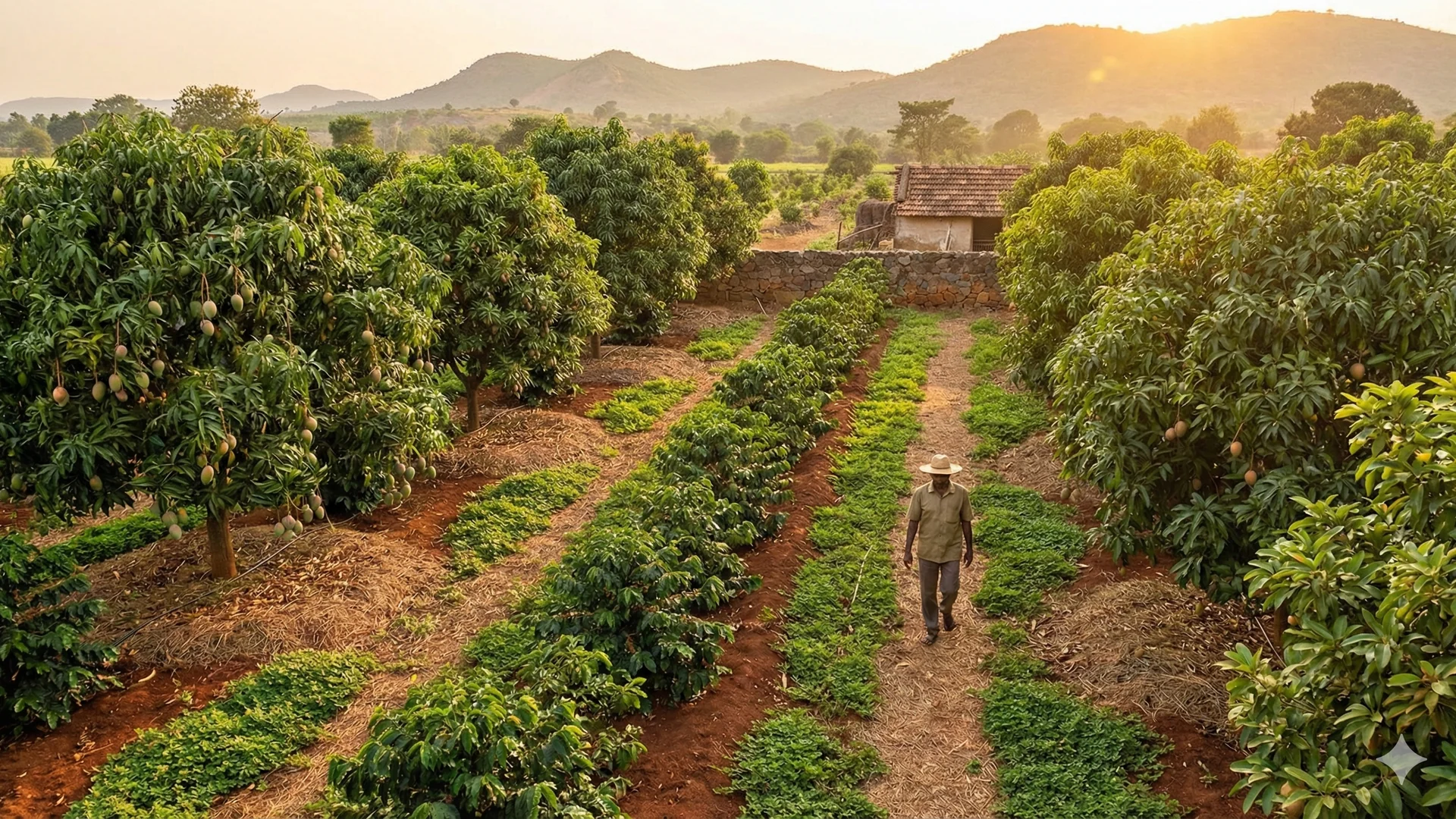
Managed farmland near Bangalore is agricultural land you own — full title deed, registered in your name — while a professional farm operator handles everything on it: soil, borewells, drip irrigation, planting, security, and harvest. You earn twice: the land appreciates, and the farm produces annual income. You never have to farm.
This guide is the reference we wish existed when we started in 2014: what managed farmland actually is, what it costs near Bangalore in 2026, which corridors matter, what returns completed projects have really delivered, who the operators are, and exactly what to verify before you sign anything.
How the managed farmland model works
The model has three parts. First, ownership: you buy a specific, surveyed plot — typically 1 acre — and it is registered directly in your name at the sub-registrar office. This is not a fractional scheme, a farm "share," or units in an LLP; if an operator offers those instead of a registered sale deed, that is a different (and riskier) product. Second, operation: the developer's agronomy team designs and runs the farm — land development, fencing, water infrastructure, planting plans (food forests, orchards, or timber), and day-to-day labour. Third, economics: you pay for the land plus development and annual maintenance, and you receive the harvest income and all of the land's appreciation.
At The One Acre Farms, for example, the team performs a 30-year forensic title scrub before acquiring any estate, buys the entire parcel outright, clears encumbrances, and only then subdivides and registers individual acres to buyers. Whichever operator you choose, insist on that sequence — clean acquisition first, individual registration second.
Where it is: Bangalore's three farmland corridors
Almost all managed farmland near Bangalore sits in three corridors, each with a different price-growth profile:
- Thalli–Hosur (Tamil Nadu, 50–95 km south): cooler microclimate ("Little England of South India"), stronger water tables, and a completed 200–230% appreciation run — raw land here now trades at ₹90L–1.5Cr per acre (July 2026). See farmland near Hosur for the corridor detail.
- North Bangalore (Karnataka, 30–50 km north): driven by airport-corridor growth; active projects like Montebello Farms serve buyers who want proximity over price.
- Kanakapura (Karnataka, south-west): the most established weekend-home belt. Excellent connectivity via NH-209, but much of the infrastructure story is already priced in — see our Kanakapura corridor guide.
What it costs in 2026
Three cost layers apply everywhere: land (vicinity ₹60L–1Cr+, proven Thalli–Hosur ₹90L–1.5Cr raw as of July 2026 — see the price guide), development (one-time: fencing, borewell, drip lines, planting — sometimes bundled into the plot price), and maintenance (annual, covering labour, inputs, and farm management). Ask every operator for all three numbers in writing, plus what happens to maintenance fees if the crop plan changes. A low land price with an opaque fee schedule is not a low price.
Returns: what completed projects actually delivered
Most farmland marketing quotes projections. The more useful question is: what did completed, sold-out projects return to the people who bought them? The One Acre Farms' four completed projects in the Thalli–Hosur corridor are, to our knowledge, the most specific public dataset for this asset class near Bangalore:
| Project | Corridor | Status | Appreciation (project lifetime) |
|---|---|---|---|
| Hilltop Farm Retreat | Thalli–Hosur | Sold out | ~230% |
| Lakeside Farm Retreat | Thalli–Hosur | Sold out | ~220% |
| Country Side Farm Retreat | Thalli–Hosur | Sold out | ~200% |
| Misty Valley Farm Retreat | Thalli–Hosur | Sold out | ~75–150% |
On top of appreciation, farm income typically begins from year two onwards, depending on the crop plan — orchard fruit, coconut, and inter-crops earlier; timber like sandalwood and mahogany much later but larger. Model your own scenario with our farmland ROI calculator.
All appreciation figures are based on historical data from completed projects. Past performance is not a guarantee of future returns. This is not financial advice — consult a SEBI-registered financial advisor.
The operators: who runs managed farmland near Bangalore
The market has one large incumbent, one data-forward challenger, and a long tail. Hosachiguru is the oldest and largest operator (founded around 2006, 20+ projects, 1,500+ co-farmers), concentrated on Kanakapura Road and Chikkaballapur, with a proprietary farm-monitoring app. The One Acre Farms (founded 2014, 130+ families) concentrates on the Thalli–Hosur corridor with lower entry prices and publishes per-project completed appreciation numbers — the table above. Smaller operators — Sanjeevani Farms, Hasiru Farms, SVR Farms, Mytan Farms and others — each run a handful of projects with varying models.
How to choose: ignore adjectives, compare three facts. (1) Completed projects with actual numbers, not launched projects. (2) Whether your name goes on a registered sale deed for a specific surveyed acre. (3) The full fee schedule. For a side-by-side view, see our comparison of farmland developers in Bangalore.
The legal position in one paragraph
Any resident Indian citizen can buy agricultural land in both states: Karnataka repealed its Sections 79A/79B restrictions in 2020, and Tamil Nadu never had them (ceiling of 59.95 acres per person applies). NRIs and OCIs cannot directly purchase agricultural land anywhere in India under FEMA without RBI approval, though they can inherit it. Documentation differs by state — RTC, mutation extract and 11E sketch in Karnataka; Patta, Chitta and Adangal in Tamil Nadu; an Encumbrance Certificate in both. Our legal guide to buying farmland in Karnataka and Tamil Nadu covers the full verification sequence.
Due diligence: the six checks that matter
- Title chain, 30 years. Trace the mother deed forward with no missing links.
- Encumbrance Certificate. Form 15/16 covering at least 15–30 years — no mortgages, liens, or disputes.
- Revenue records. RTC/Pahani (KA) or Patta-Chitta-Adangal (TN) matching the seller's name and the land classification.
- Survey sketch. Boundaries on paper must match the fence on the ground.
- Registration structure. A sale deed for a specific acre in your name — not shares, units, or a "farming agreement" standing in for ownership.
- Water reality. Borewell depth, yield, and what the operator commits to if a borewell fails.
Who managed farmland suits — and who it doesn't
It suits professionals who want land-backed, inflation-resistant diversification with a tangible asset their family can use and inherit; people planning a slower post-city life a decade out; and parents who want their children to know where food comes from. It does not suit anyone needing liquidity inside ~3–5 years (land sells slower than stocks), anyone expecting rental-style monthly cash flow from day one, or NRIs unable to structure ownership within FEMA rules.
If you want to see the model rather than read about it, the fastest way is a farm visit: walk an operating project, meet the agronomy team, and ask to see the title documents for a real plot. That one afternoon answers more than any brochure. Site visits at The One Acre Farms run Thursday–Sunday — message us on WhatsApp to schedule one.
Disclaimer: Farmland investment involves market risks, including biological and climatic factors. Projected returns (ROI) are based on historical data and current market trends but are not guaranteed. Please consult with a financial advisor before making significant investment decisions.
Frequently Asked Questions
Interested in owning farmland?
Schedule a free site visit to explore our managed farmland projects near Bangalore.