We reject roughly 85% of the land parcels we scout — which means we spend most of our time looking at exactly the parcels and practices this checklist warns you about. Here is what two decades of buying land teaches you to check before trusting any developer, including us.
1. Whose name is on the deed?
The question that outranks all others. The only safe answer: yours, by individual registered sale deed, for a specific surveyed plot, followed by mutation of the revenue records into your name. If the answer involves "units", "shares", a "club membership", or a "farming agreement" standing in for ownership, you are buying paper issued by a company, not land — and if that company fails, its creditors stand ahead of you. Every plantation-scheme collapse in Indian history hurt buyers on exactly this point. Read how a clean structure works before comparing anything else.
2. Completed projects — with real exits
Launched projects prove marketing; completed projects prove execution; resales inside completed projects prove everything — that buyers got titles clean enough to sell, at prices worth selling at. Ask: "describe one actual resale in your completed projects." In our own projects, every completed development has recorded co-farmer resales — two of them, with names and numbers, are documented here. A developer who cannot describe a single real exit is asking you to be the first.
3. All three cost layers, in writing
Managed farmland has exactly three cost layers: the land price, one-time development (fencing, borewell, drip, planting), and the annual management fee. A low headline price with an opaque fee schedule is not a low price. Insist on all three in writing, plus the answer to: "how is the management fee revised, and what happens if the crop plan changes?"
4. How do they verify sellers? (The question almost nobody asks)
Here is a truth from the buying side that most content never mentions: the official papers are not the ultimate source of truth. Sellers sometimes distort family facts during a sale — an undisclosed second wife, an understated count of legal heirs. No Encumbrance Certificate reveals that; each undisclosed heir is a future claim on your land. That is why we do not operate in areas where we have no direct associates on the ground — seller families are verified through village-level relationships before we buy. Ask your developer how they do this. "Our lawyer checks the documents" is a paper-only answer to a problem that lives beyond paper.
5. Never pay to view land
Genuine sellers and developers earn by selling land, not by showing it. A "site visit charge" or "seriousness fee" — typically ₹2,000–5,000 — is the clearest single signal that the listing itself is the product. The full anatomy of that ecosystem is documented in the cheap land trap.
6. Price far below the benchmark is the red flag, not the bargain
No genuine seller near Bangalore prices an acre at a fraction of what every neighbour knows it is worth. Calibrate yourself with observed data — our quarterly Bangalore Farmland Price Index publishes corridor bands from actual transactions — and treat anything dramatically below the band as a question ("what's missing — road, papers, or water?") rather than an opportunity.
7. "Proposed" priced as "confirmed"
Airports, expressways, metro extensions — corridor marketing loves them. Our standing rule: proposed projects are just that, proposed, till any stone is moved. A developer pricing tomorrow's infrastructure into today's land is asking you to carry the government's execution risk. The corridor should stand on what already exists.
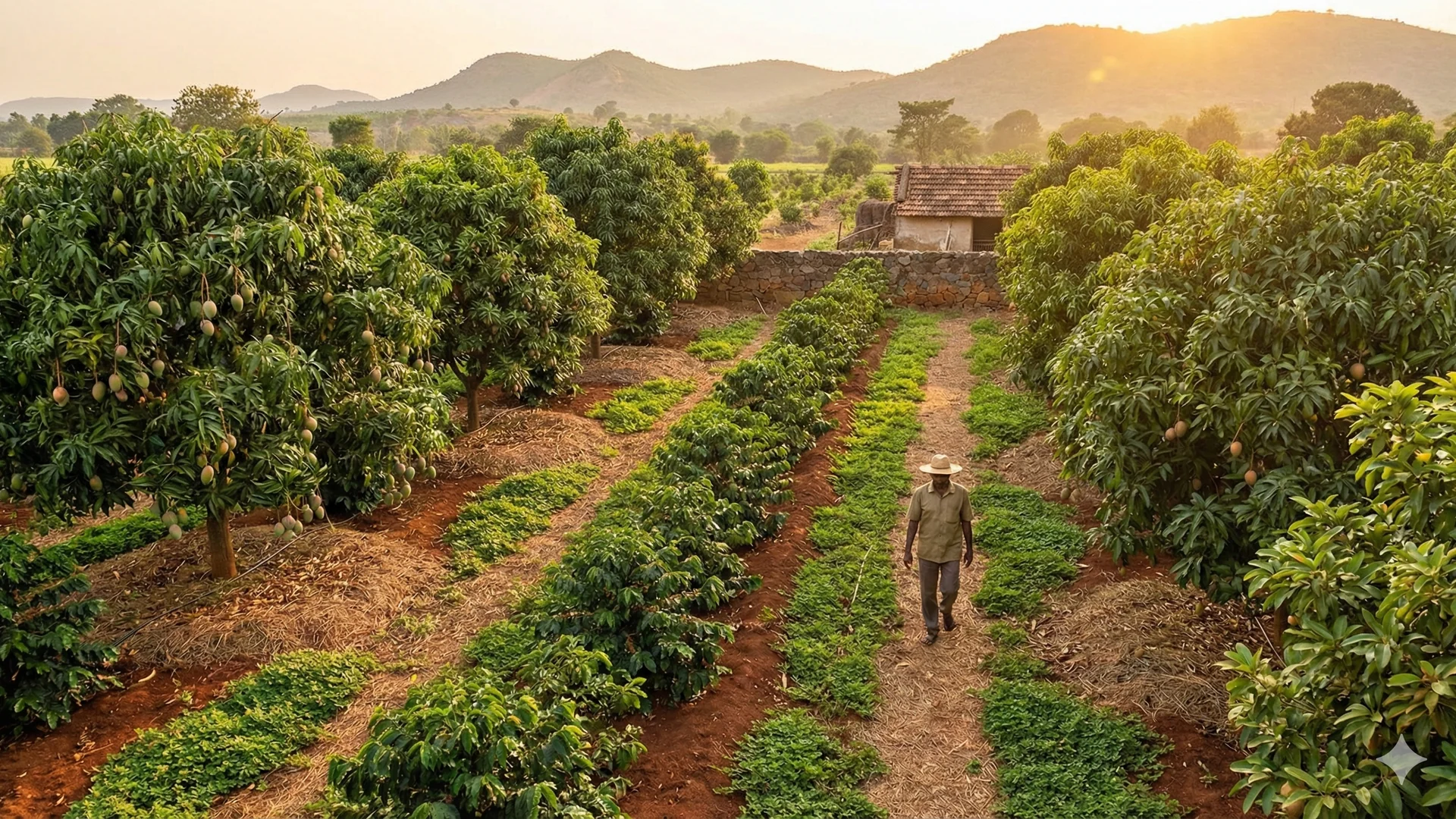
8. Walk a working farm
The final filter costs one Saturday: visit. A real operation shows you title documents for actual plots, borewell records, crops in the ground, and co-farmers who will talk to you. A scheme shows you a gate, a sales office, and a render. If the developer hesitates at "can I speak to an existing co-farmer alone?" — that hesitation is your answer.
The checklist, in one place
- Individual registered sale deed in your name — or walk away.
- At least one describable, real resale inside a completed project.
- Land + development + annual fee, all in writing.
- Seller-family verification beyond documents — ask how.
- No fee to view land. Ever.
- Price consistent with observed corridor bands.
- Infrastructure labelled proposed vs confirmed — and priced accordingly.
- A working farm you can walk, with co-farmers you can question.
Run every developer — including us — through all eight. The good ones will enjoy the questions.
Disclaimer: Land laws and regulations vary significantly between states (Karnataka vs. Tamil Nadu) and are subject to frequent amendments. This guide is for informational purposes only and does not constitute legal advice. Always perform independent due diligence through a qualified advocate.
Frequently Asked Questions
Interested in owning farmland?
Schedule a free site visit to explore our managed farmland projects near Bangalore.