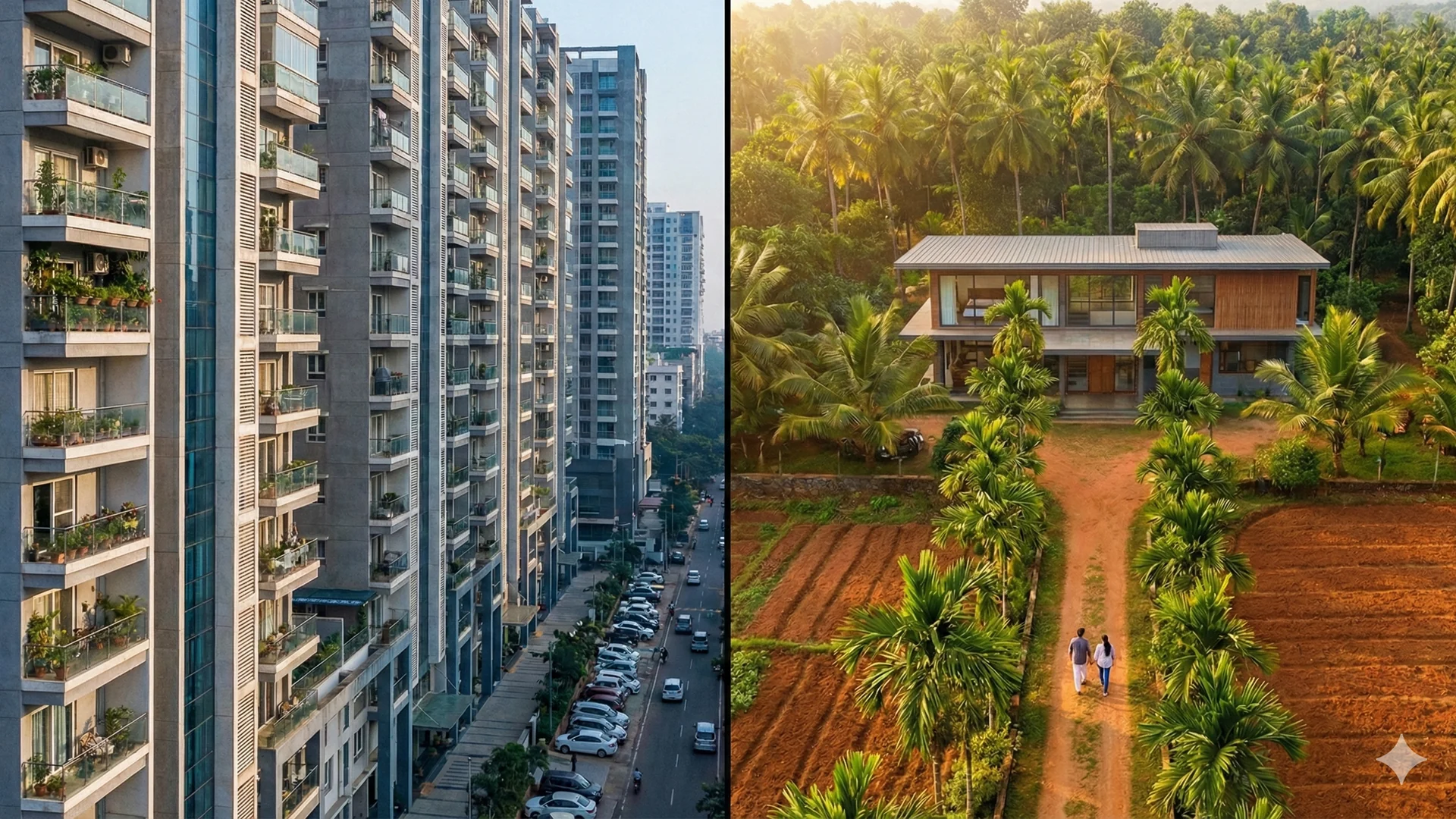
Bangalore's skyline is rising, but its soil is maturing. For the modern investor, the choice often boils down to two extremes: the glass-and-steel luxury apartment or the green-and-brown managed farm.
The Battle for ROI
The standard investment playbook in Bangalore for the last 20 years was simple: buy a 3BHK in an emerging corridor, rent it out, and wait for the price to double. However, as the urban real estate market reaches saturation and entry costs soar, investors are looking for "Untapped Value."
Managed Farmland has moved from being a "hobby asset" to a serious institutional-grade investment. Let's look at the numbers.
Direct Value Investment
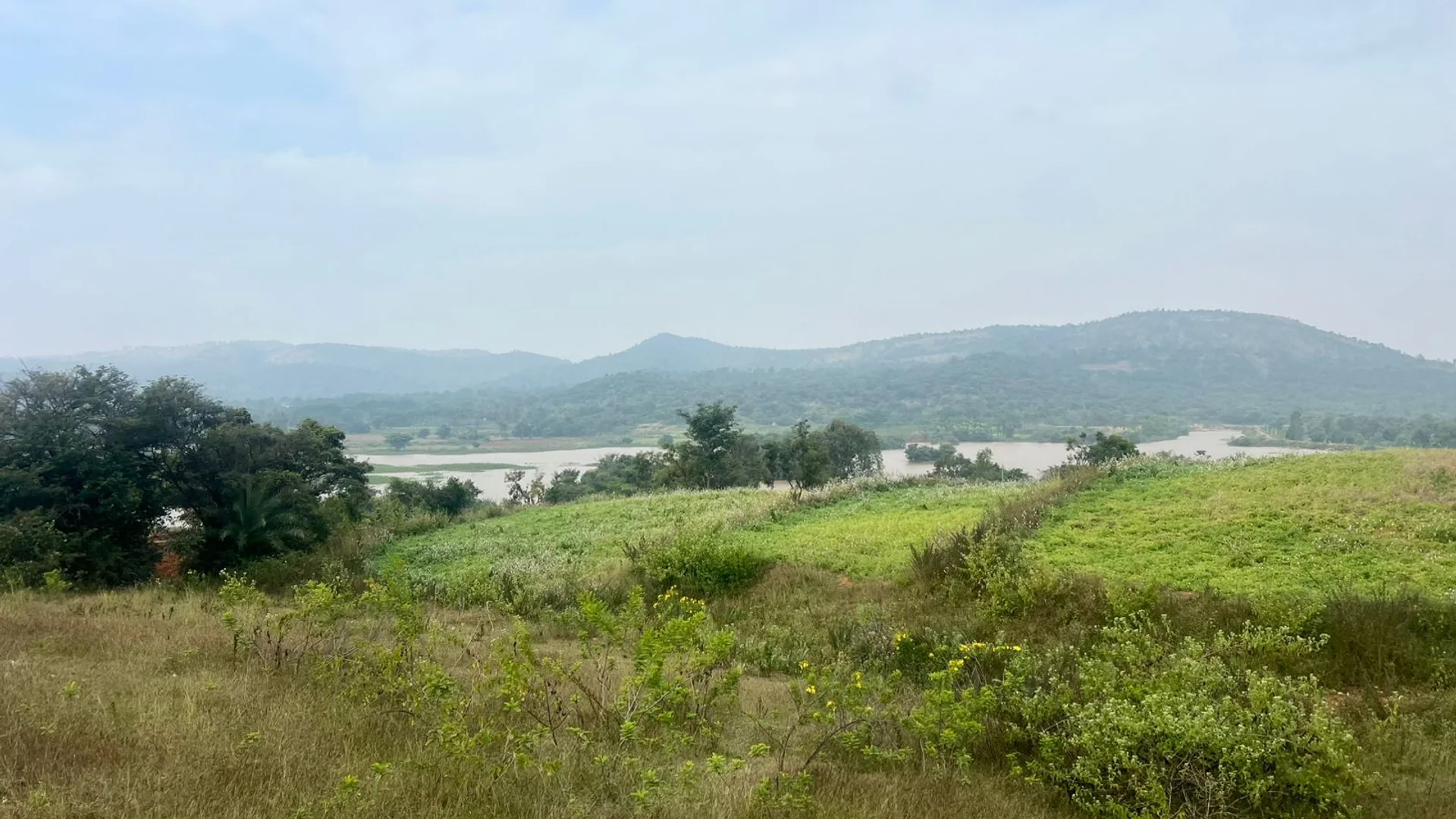
Why pay for a developer's marketing budget when you can buy raw, producing land? Our Vriksha plots offer a pure land-play with high agricultural upside.
Compare Investment PlotsThe Head-to-Head Comparison
| Metric | Luxury Apartment | Managed Farmland |
|---|---|---|
| Entry Ticket | ₹1.5 Cr - ₹4 Cr+ | ₹45 Lakhs - ₹80 Lakhs (per acre) |
| Appreciation | 8-12% (Location dependent) | 15-25% (In strategic corridors) |
| Holding Cost | High (Maintenance, Property Tax) | Low (Shared management fees) |
| Yield Type | Rent (Taxable) | Harvest Sharing (Tax-Free*) |
| Asset Life | Depreciating building | Appreciating land + biological asset |
The Depreciation Trap
When you buy an apartment, you are buying a product that has a finite life. The building starts aging the moment it is finished. In 30 years, the structure might have zero value, and you are left only with the "Undivided Share" of the land.
In contrast, a managed one-acre farm is a "Vibrant Asset." The trees you plant today grow more valuable every year. The soil, through regenerative practices, becomes more fertile. You are investing in a system that improves over time, rather than a structure that decays.
The Opportunity Cost of Opportunity
When you lock ₹2 Crores into an apartment, you are also locking in a set of fixed urban risks: traffic congestion, water shortages, and potential over-supply in the luxury segment. By diversifying even 30% of that capital into a managed one-acre farm, you are buying "Optionality."
During times of urban crisis—whether it's a pandemic or an infrastructure collapse—the value of your farm sanctuary becomes priceless. This "Social ROI" is something an apartment can never provide. To see how this optionality fits into a long-term strategy, explore our Managed Farmland Retirement Guide.
Risk-Adjusted Returns: The Managed Advantage
Every investment has a risk profile. The risk of farmland used to be "Total Neglect." But in a managed community, that risk is neutralized by a professional team. When you calculate the "Risk-Adjusted Return"—the profit you make relative to the stress and effort you put in—managed farmland often beats apartments by a wide margin.
You are not chasing 2% rental yields; you are participating in the growth of a biological asset that is protected by high-perimeter security and 30-year management cycles. This is the difference between being a landlord and being a landowner.
Tax Arbitration: The 30% Difference
When running a true financial model comparing luxury apartments to managed farmland, most investors forget to factor in the tax drag. If you earn ₹20 Lakhs in rental income from a luxury apartment in Koramangala, it is added to your primary income. If you are in the 30% tax bracket, you immediately lose ₹6 Lakhs to income tax. Your "gross" yield of 3% is actually a "net" yield of 2.1%.
Agricultural income works differently. Under Section 10(1) of the Income Tax Act, genuine agricultural income is completely exempt from income tax. When our agronomy team harvests the timber and short-term crops (like Turmeric or Papaya) from your estate, your share of the harvest revenue is entirely yours to keep. This tax asymmetry means that a 10% gross yield on farmland is equivalent to a 14.2% gross yield on commercial real estate for an investor in the highest tax bracket.
Furthermore, if you hold the farmland for long-term appreciation, the capital gains tax implications can be highly favorable, especially if the land falls outside strict urban agglomeration limits. This is a primary driver behind the massive demand we see for our Managed Farmland near Bangalore for sale. It is not just about the gross return; it is about how much of that return you actually keep.
Liquidity Myths vs Reality: The Secondary Market
The most common objection to buying land is liquidity. "If I buy an apartment, I can sell it quickly. If I buy land, my money is stuck." Ten years ago, this was true. Buying a standalone, unmanaged parcel of land meant you had to personally find a buyer, negotiate, navigate the registrar's office, and pray the boundaries weren't encroached open in the meantime.
The managed farmland model flips this narrative. Because the asset resides within a secure, professionally managed ecosystem with a proven track record, it is significantly easier to sell. When an investor decides to exit a plot at a community like the Hilltop Farm Retreat, they are not selling "raw land." They are selling an established, income-producing biological asset with clear fencing, water infrastructure, a fully grown timber canopy, and a clean title history.
In our experience, established managed farm plots in premium locations often experience higher demand in the secondary market than luxury apartments in over-supplied corridors. The buyer pool consists of other High-Net-Worth Individuals (HNIs) who missed out on the initial launch and want a mature, risk-free asset that is already producing yields. This creates a "Goldilocks" liquidity scenario: not as fast as liquidating a mutual fund, but significantly faster and cleaner than selling disputed, unmanaged real estate.
Conclusion: Diversify into the Earth
In 2024, the winning portfolio isn't one that ignores the city, but one that balances it. If your net worth is heavily concentrated in Bangalore's urban landscape, adding a managed one-acre farm provides the perfect "Non-Correlated" hedge. When the city gets crowded, the farm provides space. When the economy gets volatile, the land provides stability.
Ready to Pivot Your Portfolio?
Join our next investment seminar and see a detailed breakdown of farmland economics. Discover why top-tier investors are re-allocating away from commercial and residential into managed habitats.
Explore More Farm Opportunities
- See the full side-by-side comparison with real OAF return data in our Farmland vs Apartment Investment guide.
- Discover your ideal rural escape with our land unit converter.
- Deepen your research by exploring our farmland investment guide.
- Farmland Price Per Acre Bangalore
- Organic Farming Near Bangalore
Myth vs. Reality
"Rental income from apartments is guaranteed."
"It's harder to get a loan for farmland."
"Land has 'litigation' risks that apartments don't."
Frequently Asked Questions
Interested in owning farmland?
Schedule a free site visit to explore our managed farmland projects near Bangalore.