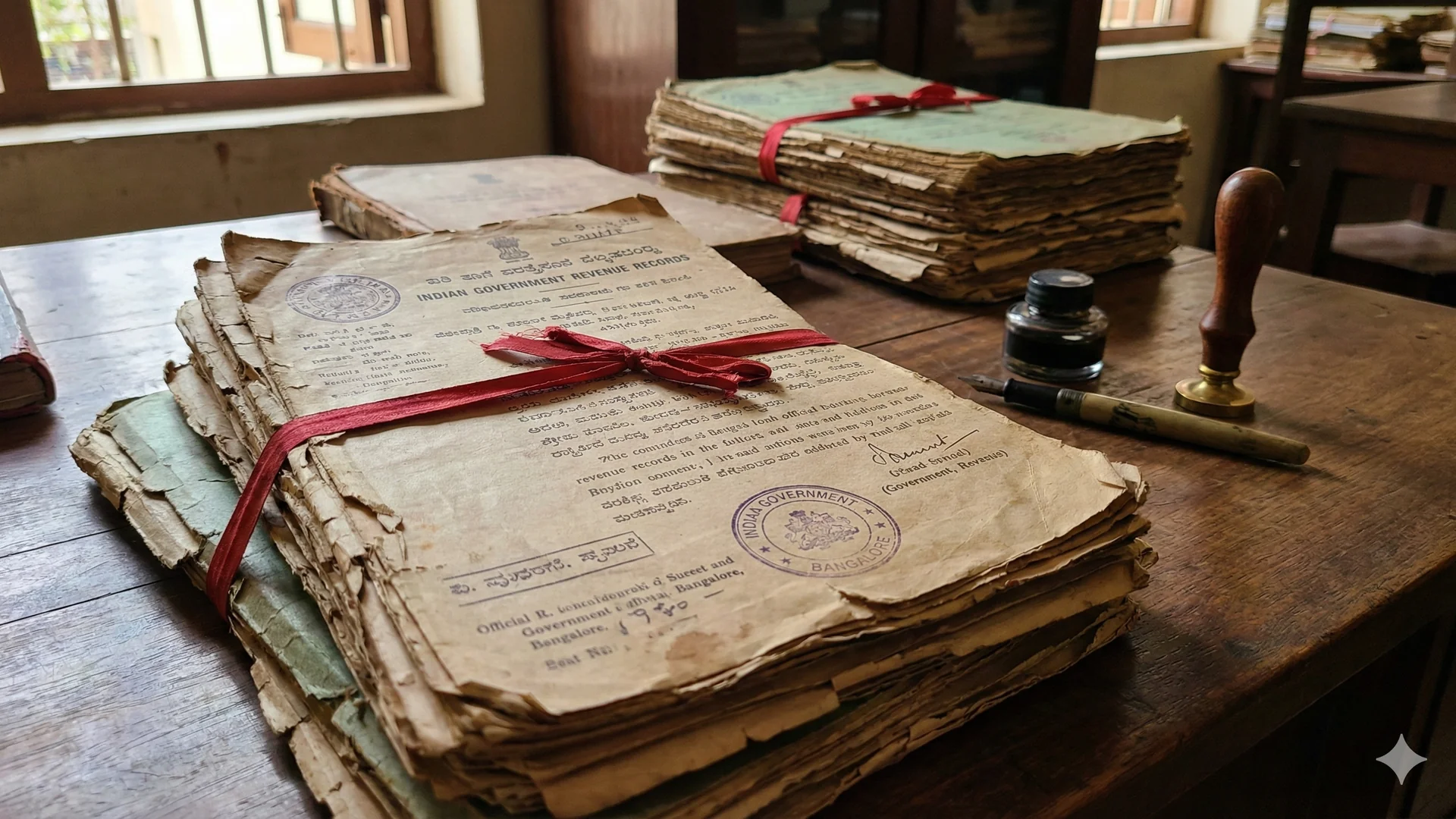
Two documents decide whether a farmland purchase is safe or a trap: the Patta (ownership register) and the Encumbrance Certificate (liability register). Most buyers glance at them and nod. Here's how to actually read them.
Key Takeaways
- 1. Patta (A-Register) confirms current legal owner and land classification — verify name, survey numbers, and area match the sale deed exactly
- 2. Encumbrance Certificate (EC) shows 30-year transaction history — any suspicious gaps or unexplained entries warrant a legal review
- 3. Both documents are available on Tamil Nadu's Tamil Nilam portal — insist on original certified copies even if digital copies are provided
- 4. Red flags: multiple A-Register entries for the same survey number, EC with mortgage or lease entries not reflected in Patta, names that don't match the seller
- 5. OAF handles full due diligence for every plot — 30-year EC, verified Patta, FMB sketch, and legal title report before you sign anything
Already done for you — in our projects
Every plot in our projects in Tamil Nadu comes with a 30-year EC, verified Patta, FMB sketch, and legal title report — prepared before you sign anything. You review; we handle.
View Available ProjectsWhy These Two Documents Matter Above All Others
In Tamil Nadu's land record system, the Patta tells you who owns the land, and the Encumbrance Certificate tells you what claims exist on it. Together, they are the foundation of any agricultural land due diligence. Everything else — the sale deed, the FMB sketch, the crop records — is secondary to these two.
Tamil Nadu's "Tamil Nilam" portal has made both documents digitally accessible, which is a major improvement over a decade ago. But knowing how to interpret them — what each column means, what gaps or flags to watch for — requires hands-on experience that most buyers simply don't have.
Part 1: Reading the Patta (A-Register)
What is a Patta?
A Patta (also known as the A-Register or Village Account No. 1) is the primary revenue record maintained by the Village Administrative Officer (VAO) that registers the ownership of agricultural land. It is issued by the Tahsildar's office and is the official government record of who owns the land.
Important: A Patta is a revenue record, not a title document. It establishes possession and revenue payment, but legal ownership is established through the registered sale deed. Both must match perfectly.
Key Fields in a Patta — What to Check
| Field (Tamil / English) | What It Means | What to Verify |
|---|---|---|
| Survey No. / தனி) | Unique number assigned to the plot by the Revenue Dept | Must match sale deed, FMB sketch, and EC exactly |
| Pattadar Name (பட்டதாரர்) | Registered landowner's name in government records | Must match the seller's name and ID documents precisely |
| Extent (விஸ்தீர்ணம்) | Total area of land in Hectare/Acre | Must match amount being sold. Partial plot sales need sub-division |
| Nature of Land (நிலத்தின் தன்மை) | Nanjai (wet/canal-irrigated) or Punjai (dry/rainfed) | Punjai is more flexible for construction; Nanjai has stricter conversion rules |
| Tax / Kist (குத்தகை) | Annual land revenue amount due to government | Should be current — no arrears. Check receipts for last 3 years |
| Remarks Column | Any government orders, court cases, or encumbrances noted | 🚨 Should be blank. Any entry here is a red flag requiring legal review |
The Chitta and Adangal: Patta's Companions
The Patta is often presented alongside the Chitta (Area Register) and Adangal (Cultivation Register). The Chitta confirms the extent of cultivation, and the Adangal records what crops are grown and who is actually cultivating the land.
If the Adangal shows a different person cultivating the land than the Patta owner, investigate — it could indicate a lease, a tenant cultivator, or a disputed possession.
🚨 Red Flags in a Patta
- → Seller's name doesn't exactly match (spelling variations can indicate a different person)
- → Multiple names on the Patta (joint ownership — all co-owners must sign the sale deed)
- → Survey number has "sub-division" notation not yet updated (means split land with pending records)
- → "Panchami Land" classification (SC/ST protected land — cannot be sold to general category)
- → Any entry in the Remarks column (court order, mortgage, dispute)
Part 2: Reading the Encumbrance Certificate (EC)
What is an Encumbrance Certificate?
An Encumbrance Certificate (EC) is issued by the Sub-Registrar's office and records all registered transactions on a property: sales, gifts, mortgages, court attachments, and lease agreements. It is your liability ledger for the land.
For agricultural land, always request a 30-year EC — not 13 years as many people practice. Old mortgages, inheritance disputes, and trust/family deed complications often lurk beyond the 13-year window and can surface at resale or court proceedings decades later.
How to Read the EC — Column by Column
A Tamil Nadu EC has a standard multi-column format. Here's what each section means:
Serial Number & Date
Each registered transaction listed chronologically. A long list is not bad by itself — it shows an active transaction history.
✓ Verify: Ensure the latest entry is the current seller — there should be no gap in the 'flow of title'
Nature of Document
What type of transaction: Sale, Mortgage, Release, Gift, Partition, Will, Attachment in Execution
✓ Verify: Look for any 'Mortgage' or 'Court Attachment' entries — these must be formally released before purchase
Parties (Executant / Claimant)
Who executed the document (seller side) and who is the claimant (buyer/bank side)
✓ Verify: Trace the chain: each seller must have previously appeared as a buyer in an earlier entry
Consideration / Loan Amount
Amount paid in a sale, or loan amount in a mortgage
✓ Verify: If a mortgage entry exists, verify a corresponding 'Release Deed' entry in the EC showing the loan is cleared
Property Description
Survey number, village, extent of the land covered by this transaction
✓ Verify: Must match the land you're buying. Partial matches need a lawyer to interpret
The "Nil" EC: What It Means and Doesn't Mean
A "Nil" EC means no transactions are registered for the specified period. This sounds ideal, but it also means there's no documented ownership transfer — the seller inherited the land or purchased it informally (unregistered sale). This is common with very old agricultural land.
In a Nil EC situation, you need additional documents: the family tree, legal heir certificates (if inherited), and the original grant documents from when the land was allocated to the original owner. A qualified advocate must trace the title independently.

Tamil Nadu Land Verified for You
Our dedicated legal team conducts full due diligence on every plot we sell — including 30-year EC and Patta verification. View our current TN projects.
Myth vs. Reality
"A registered sale deed is all I need. Why check the EC?"
"The 13-year EC is the standard; 30 years is overkill."
"I can get the Patta transferred to my name only after full payment."
Disclaimer: Land laws and regulations vary significantly between states (Karnataka vs. Tamil Nadu) and are subject to frequent amendments. This guide is for informational purposes only and does not constitute legal advice. Always perform independent due diligence through a qualified advocate.
Interested in owning farmland?
Schedule a free site visit to explore our managed farmland projects near Bangalore.