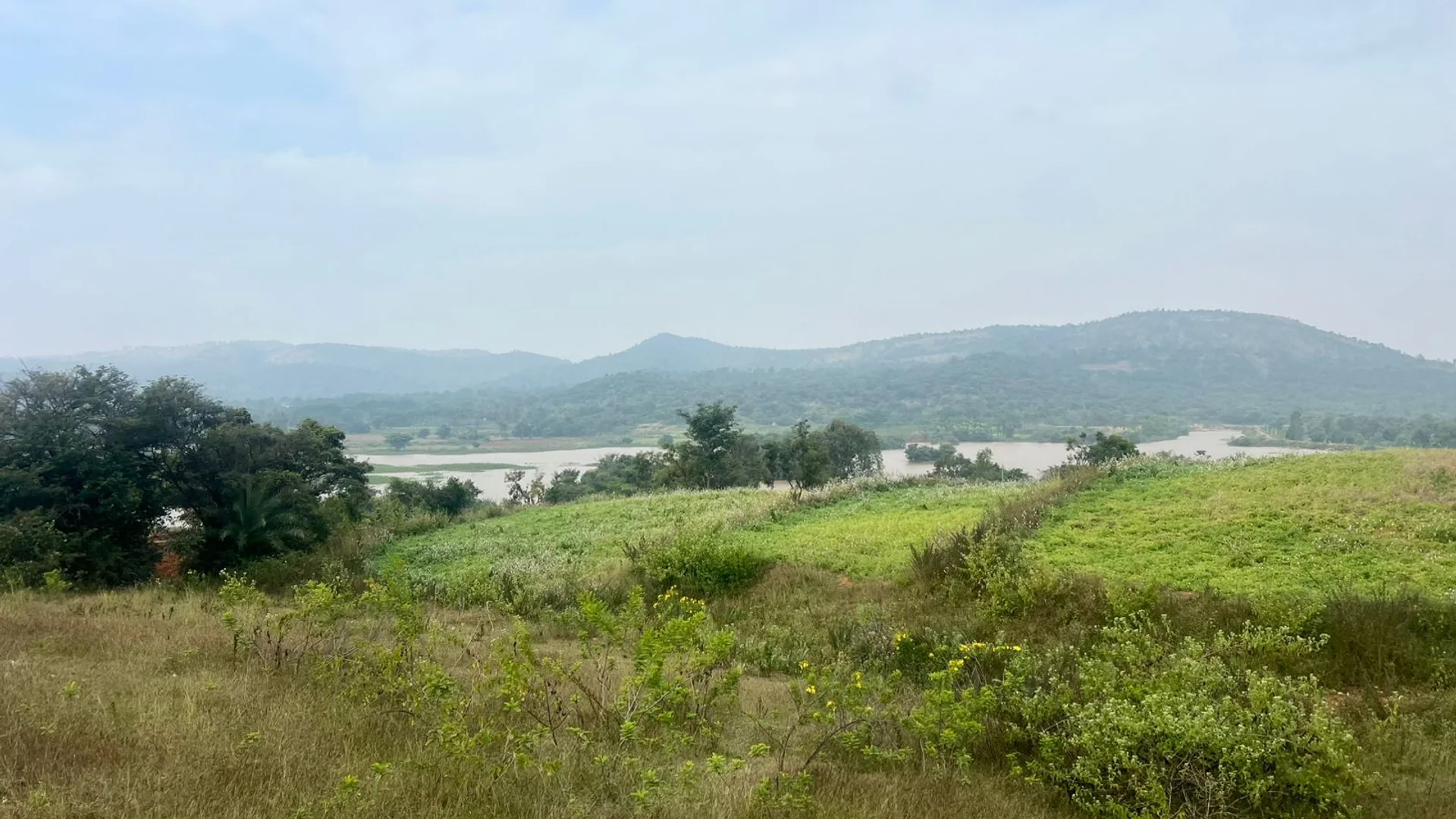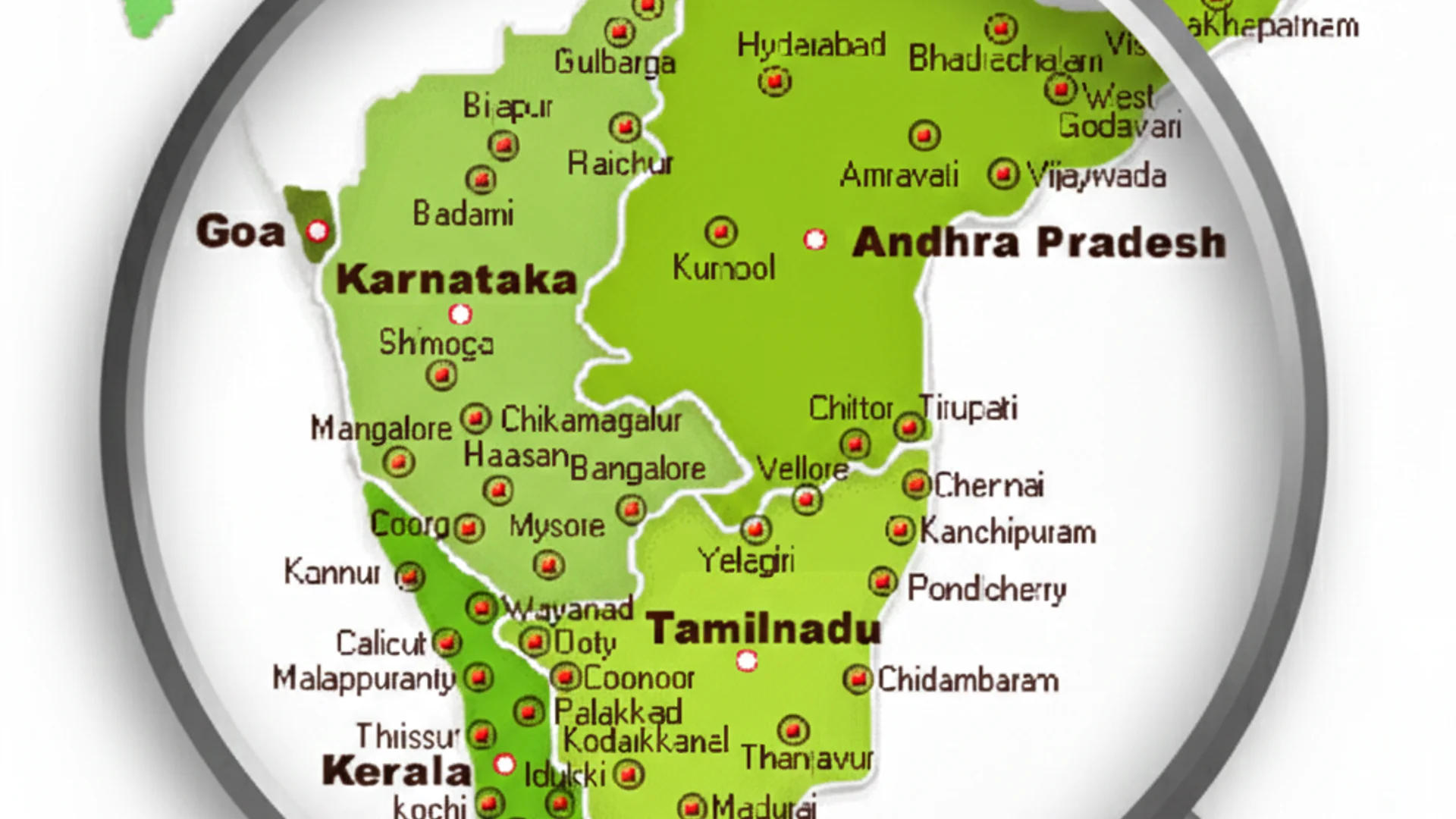
Expanding your horizon across the border into Tamil Nadu offers incredible value, but the legal landscape changes significantly. Understanding the nuances of TN land laws is the key to a safe purchase.
Nanjai vs Punjai, in short: Nanjai is wet land irrigated by a river, canal or tank. Punjai is dry land that depends on rain or wells; Manavari is rain-fed dry land. Nanjai is usually harder to convert to non-agricultural use, so check the classification in the patta and chitta before you buy.
The Bangalore-TN Corridor: Why Buyers Look Here
For many Bangaloreans, the search for the perfect farmland often leads to the border towns of Hosur, Kelamangalam, Shoolagiri, and Denkanikottai. These areas offer higher rainfall, cooler climates, and generally lower land prices than the northern or eastern fringes of Bangalore. The Chennai-Bangalore Industrial Corridor (CBIC) has accelerated infrastructure development in this region, making it one of the fastest-developing farmland corridors within 100km of Bangalore.
Tamil Nadu's land records (Tamil Nilam) and legal frameworks have their own terminology and rules that differ significantly from Karnataka. Understanding these differences is not optional — it is the price of entry for anyone serious about owning farmland in Tamil Nadu. This guide covers everything from Patta verification to Panchami land risks, drawing on transaction data from The One Acre Farms' completed projects in the region.
But before you dive in, you must master the local legalities. Here are the 10 points to check before you sign a single document.
2026 Updates to Tamil Nadu Land Law
Tamil Nadu has accelerated its land digitisation programme since 2023. The Tamil Nilam portal now offers near-complete coverage of Patta and Chitta records for rural land across all 38 districts, and the Sub-Registrar's office has extended online EC applications to all districts. The state government also introduced updated land conversion fees in 2024, making the conversion process from agricultural to residential use more standardised — though timelines still vary by district.
Sub-Registrar office reforms (2024-2025): The Tamil Nadu Registration Department introduced a revised fee structure that reduced stamp duty for agricultural land transfers in certain districts, and the introduction of e-stamping has eliminated the risk of fake stamp papers. Online slot booking for property registration is now available in 34 of 38 districts.
Chennai-Bangalore Industrial Corridor impact: The CBIC passes through Krishnagiri and Dharmapuri districts, bringing new expressways, logistics parks, and industrial zones within 20km of prime farmland areas near Hosur.
Key 2026 note: Both Karnataka and Tamil Nadu now allow any Indian citizen to purchase agricultural land without restriction. Karnataka's previous restrictions were amended in 2020. Tamil Nadu has no such restriction — making TN farmland a legally straightforward purchase for Bangalore buyers. Consult a TN-registered advocate before purchasing.
1. Understand Land Classification: Punjai vs. Nanjai
In Tamil Nadu, land is primarily classified as Punjai (Dry Land) or Nanjai (Wet Land). This classification is one of the most important determinants of what you can and cannot do with the land, and it affects everything from construction permits to agricultural yields to future resale value.
Nanjai land is generally served by canals or rivers and is often restricted from being converted for residential or non-agricultural use to protect food security. The Tamil Nadu government's stance on Nanjai land is clear: it exists to ensure the state maintains adequate agricultural production, particularly in water-abundant regions. If you purchase Nanjai land and later attempt to convert it to residential use, you will face significant regulatory hurdles, extended timelines, and potentially outright rejection.
Punjai land, which relies on rainwater or wells, is more flexible. It offers more freedom in terms of construction and long-term land use transitions, making it the preferred classification for farmland near Bangalore's border corridors. Most of The One Acre Farms' projects in Tamil Nadu are on Punjai land precisely for this reason.
Beyond Punjai and Nanjai, land is also classified in the revenue records into special categories such as temple land, burial-ground land or poramboke (government) land. These special classifications can impose additional restrictions. Always verify the land's classification is "Agricultural" and not a special category before purchasing.
2. The Patta: Your Proof of Ownership
The Patta is the most important document in Tamil Nadu land transactions. It is the revenue record that establishes who the legal owner of the land is according to the state government. The name "Patta" derives from the Tamil word for "title deed" — though it is not itself a title deed in the sense of a registered sale deed, it is the government's official record of who holds rights over a particular parcel of land.
When buying farmland in Tamil Nadu, you must verify three related but distinct records: the Patta (the ownership record showing the name of the current holder and the land extent), the Chitta (which shows the breakdown of land extent in different measurement units — guntas, cents, acres), and the Adangal (which shows the cultivation history, crops grown, and the name of the actual cultivator). These three documents together give you a complete picture of the land's legal status.
In recent years, the TN government has digitised these records through the Tamil Nilam portal (tnrlms.gov.in). A clear, computerised Patta in the seller's name is non-negotiable. Ensure that the total extent of land mentioned in the sale deed matches the Patta exactly — discrepancies as small as 2-3 guntas can create legal disputes that take years to resolve.
Critical check: Verify that the Patta is not in the name of a deceased person. If the previous owner passed away, confirm that inheritance procedures have been completed and the Patta has been transferred to the current seller's name through a legal heir certificate. We have seen cases where a seller is managing land on behalf of the family but does not have the legal right to sell it.
Also check for any vernment-issued notices or litigation hold on the Patta. Sometimes government departments (particularly the Revenue Department or the Agricultural Department) will place a hold on a Patta for various reasons — land acquisition proposals, subdivision disputes, or recovery of agricultural loans. Run a full search at the taluk office before concluding the purchase.
3. The 30-Year Encumbrance Certificate (EC)
While many people check the Encumbrance Certificate for 13 years — the standard period for urban residential property — for agricultural land in Tamil Nadu, you must go back at least 30 years. This is not a suggestion; it is a rule derived from decades of case law in Tamil Nadu courts where hidden encumbrances have surfaced decades after a transaction.
The purpose of the 30-year EC search is to identify any old mortgages, family partitions, unregistered transactions, court attachments, or long-forgotten litigations that could cloud the title. Agricultural land in Tamil Nadu has a long history of being passed down through generations, subdivided among family members, and occasionally encumbered informally through oral agreements that later become disputed.
Ensure there is a "Flow of Title" that is unbroken from one owner to the next. If the land has been inherited, check for "Legal Heir Certificates" to ensure all siblings or branches of the family have signed off on the sale. This is especially critical in Tamil Nadu because of the state's succession laws that give equal rights to all legal heirs — male and female — under the Hindu Succession Act as amended in 2005.
How to read an EC: Look for entries marked "Mortgage," "Assignment," "Gift," "Exchange," or "Partition." Any transaction that shows the land moving from Party A to Party B should have a corresponding subsequent transaction showing it moving to Party B's heirs or assigns. Gaps in the chain — where land appears to jump from one owner to a completely unrelated person without documentation — are red flags.
In practice, the EC is obtained from the Sub-Registrar's office where the property is located. For agricultural land near Hosur, this would be the Hosur Sub-Registrar office. The EC search fee is nominal (approximately ₹100-500 depending on the land value), but the lawyer's fee for analysing it properly can range from ₹5,000 to ₹25,000 depending on complexity.
4. Beware of Panchami Land (SC/ST Land) — The #1 Risk in TN Farmland
This is perhaps the biggest and most commonly underestimated risk in Tamil Nadu farmland transactions. Panchami land (also called "SC/ST land" or "reserved land") was land distributed to Scheduled Castes and Scheduled Tribes during the British era under the Madras Tenancy Act and subsequent post-independence government schemes. By law, this land cannot be sold to non-SC/ST individuals — and this restriction does not expire.
Even if a sale happened 50 years ago, the government can reclaim it today without compensation. This is not a theoretical risk — it has happened to buyers who purchased Panchami land in good faith from sellers who claimed to have the right to sell. The courts have consistently upheld the government's right to recover such land regardless of how many hands it passed through.
How to identify Panchami land: The survey number will appear in the "A-Register" (also called the Village Administrative Officer's Register) as a Panchami land entry. Your lawyer must physically visit the VAO office and check the A-Register — this cannot be done online. The Patta will not always indicate that the land is Panchami, so the physical VAO records check is mandatory.
A second check: the Taluk Land Tribunal (also called the "25-acre tribunal" in older references) maintains records of all protected agricultural land. If a seller produces a "Land Tribunal Clearance Certificate," it confirms the land is not Panchami land — though obtaining this certificate takes 3-6 months.
In our managed farmland projects at The One Acre Farms, we run this check across multiple government records as part of our standard due diligence, which takes 4-8 weeks before any plot is offered to co-farmers. No exceptions, ever.
5. Road Access & Cart Track Rights — Don't Buy Landlocked Property
Many beautiful TN farms are "landlocked" — meaning they have no direct access to a public road. This is one of the most common issues our due diligence team finds in independent land purchases, and it can completely block the usability and resale value of the land.
Verify the "Mamool Cart Track" (also called a "poromboke" or "common land" path) rights. Just because there is a mud road doesn't mean you have the legal right to use it. It must be marked in the FMB (Field Measurement Boundary) sketch as a public path, a "path to easement," or a shared cart track with documented rights of way.
Under Tamil Nadu's Easement Act and the Transfer of Property Act, you can acquire a right of way over a neighbouring property if the land has been used as a path for at least 20 years without interruption. However, formalising this into a legal easement requires a court process and is expensive. It is far better to buy land with clear, documented road access from day one.
In our managed projects at One Acre Farms, we ensure that every plot has legal, documented road access and high-quality internal infrastructure, eliminating one of the biggest headaches of independent land buying.
Waterfront land special case: If the land borders a lake, tank, or river, verify whether the "poramboke" (government-owned vacant land) designation includes the tank foreshore. In Tamil Nadu, land within 100 feet of a water body is often treated as poramboke and cannot be owned privately. Check the FMB sketch carefully.
6. Infrastructure Corridors & Buffer Zones — Chennai-Bangalore Industrial Corridor
Check if the land falls under any buffer zones for forest land, water bodies, or major infrastructure projects. Specifically, the areas around Hosur and Denkanikottai are seeing massive expansion of the Chennai-Bangalore Industrial Corridor (CBIC), which is one of the largest infrastructure projects in South India.
The CBIC passes through Krishnagiri and Dharmapuri districts, bringing new expressways, logistics parks, and industrial zones within 20km of prime farmland areas near Hosur.
Always check the Regional Environmental Plan (prepared by the Tamil Nadu State Town and Country Planning Department), the District Master Plan, and the Zonal Development Plan before purchasing. These documents, available at the respective district collector's office or town planning office, show all proposed infrastructure corridors for the next 20-30 years.
Additionally, verify whether the land falls within any environmental protection area. Tamil Nadu has specific groundwater protection regulations in certain regions that restrict deep borewell construction.
7. Land Ceiling Act — The 15 Standard Acres Rule
Tamil Nadu has strict land ceiling laws under the Tamil Nadu Land Reforms (Fixation of Ceiling on Land) Act, 1961. An individual can generally hold up to 15 "Standard Acres." If you are planning a larger estate, you must understand how "Standard Acres" are calculated based on the quality, irrigation status, and productivity of the land.
How Standard Acres work: The ceiling limit is not a simple acreage number — it is adjusted based on land quality. One acre of well-irrigated, double-cropped land might count as 2 or even 3 Standard Acres, while one acre of rain-fed, single-cropped dry land might count as only 0.5 Standard Acres. A local lawyer or revenue officer can calculate the Standard Acres equivalent for any given land parcel.
For most buyers of one-acre plots, the ceiling limit is not a concern. However, if you are purchasing multiple adjacent plots, acquiring land through inheritance, or buying as part of a family trust or company, the ceiling rules become directly relevant. Transactions that violate the ceiling act can be voided by the government, and excess land can be acquired without compensation.
One Acre Farms maintains strict compliance with all ceiling limits across our developments. When you buy a managed plot through us, we provide a ceiling compliance certificate as part of the legal documentation package, confirming that the transaction does not cause any individual or entity to exceed the ceiling limit.
8. Agricultural Electricity & TANGEDCO — Getting Connected
Free electricity for farmers is a significant benefit in Tamil Nadu. The Tamil Nadu Generation and Distribution Corporation (TANGEDCO) provides agricultural power connections at subsidized rates for bona fide farmers. However, getting a new agricultural connection can take years if there is no existing infrastructure nearby.
Agricultural vs. Domestic connections: An agricultural (Agri) connection is subsidised by the Tamil Nadu government and can power borewells, motors, and farm equipment. A domestic connection is for residential use (farmhouse lighting, appliances). If you plan to build a farmhouse, you will typically need both — an agricultural connection for farming operations and a domestic connection for the house.
Timeline reality check: From application to physical connection, a new agricultural electricity connection in rural Tamil Nadu typically takes 6 months to 3 years. The process involves a site inspection by TANGEDCO, load assessment, pole installation, and meter connection. We strongly recommend buying land with an existing, active Ag-service connection already in place — this is one of the clearest indicators that the land is genuinely agricultural and that all prior documentation was in order.
At The One Acre Farms, every project has pre-arranged agricultural electricity infrastructure. We work with TANGEDCO to ensure each plot has an existing, verified agricultural connection before co-farmers take ownership — eliminating the years-long wait that independent buyers face.
9. Digital Land Records: Tamil Nilam Portal & Online Verification in 2026
In 2026, verifying Tamil Nadu land records online is faster and more reliable than ever. The Tamil Nilam portal (tnrlms.gov.in) provides digitised Patta, Chitta, and Adangal records for most rural land across all 38 districts. You can search by survey number, sub-division, or the owner's name — a capability that was unavailable to buyers as recently as 2020.
What you can and cannot do online in 2026: Online records can confirm current ownership, land extent, and classification. However, online records cannot confirm encumbrances (mortgages, court attachments), pending litigation, or family disputes — these require physical records at the Sub-Registrar's office and the Taluk office. Always use online verification as the first screen, then follow up with physical due diligence.
Key online resources every TN farmland buyer should use in 2026: the FMB (Field Measurement Boundary) sketches are now available district-wise online, eliminating the need to physically visit the taluk office for basic boundary verification. The Chennai SRO online portal allows you to apply for Encumbrance Certificates without visiting the sub-registrar's office — though ECs for agricultural land still require the full 30-year search period to be manually processed by the SRO staff.
The Tamil Nadu Land Records Management System (TNLRMS) also now offers mobile app access for most functions, making it possible to run preliminary checks from your phone while visiting a potential property. We recommend running the online check in front of the seller during site visits — if the online Patta does not match the seller's claims, it is a deal-ending red flag.
Always cross-reference online records with physical verification. Digitisation has reduced errors dramatically, but boundary disputes occasionally arise where digital records are incomplete or where subdivisions were made without proper registry updates. The final boundary must always be physically verified on the ground with a licensed surveyor.
10. RERA Applicability: What Agricultural Land Buyers Must Know in 2026
A common misconception is that RERA (Real Estate Regulation and Development Act, 2016) protects agricultural land buyers. It does not. RERA applies exclusively to residential and commercial real estate projects where the developer is selling plotted developments or built-up properties to multiple buyers. When you buy raw agricultural land directly from a landowner — even if that land is in a managed farmland project — the transaction is governed by the Transfer of Property Act and Registration Act, not RERA.
This distinction matters significantly. A RERA-registered project offers buyers regulatory protection, mandatory project disclosures, and an appellate tribunal for disputes. An agricultural land purchase without RERA means:
- There is no RERA registration number to verify — any claim of "RERA approved" for raw farmland is false
- No regulatory authority can intervene if something goes wrong with the title
- You rely entirely on private legal due diligence and the seller's representations
- Disputes go to civil court, not a specialised real estate tribunal
When does RERA kick in? If the farmland is later developed into a plotted layout or villa project and individual plots are sold as residential property, RERA becomes mandatory at that stage. At The One Acre Farms, we ensure complete legal clarity before any project launch — and we voluntarily adopt RERA-equivalent transparency standards even in the pre-development agricultural land phase, including full disclosure of title reports and due diligence summaries to all co-farmers.
Safe TN Farmland Awaits
We specialise in legally verified farmland across the Tamil Nadu border. View our current projects.
Experience the Farm Life
Reading about farm life is one thing; living it is another. Discover our signature farm retreat where nature meets luxury.
Explore Countryside Farm RetreatExplore More Farm Opportunities
- For a complete overview, read our legal guide to buying farmland in Karnataka and Tamil Nadu.
- Sustainable Living
- For a full legal comparison of buying farmland in Karnataka vs Tamil Nadu, read our legal guide for buying farmland in Karnataka and Tamil Nadu.
- Compare land measurement units instantly with our guntas to acres converter.
- Farm Plots Doddaballapur
- Farmland Near Hosur
- how managed farmland near Bangalore works
Myth vs. Reality
"Agricultural land has murky titles."
"I can't resell agricultural land."
"I need to be a farmer on paper."
Disclaimer: Land laws and regulations vary significantly between states (Karnataka vs. Tamil Nadu) and are subject to frequent amendments. This guide is for informational purposes only and does not constitute legal advice. Always perform independent due diligence through a qualified advocate.
Frequently Asked Questions
Interested in owning farmland?
Schedule a free site visit to explore our managed farmland projects near Bangalore.