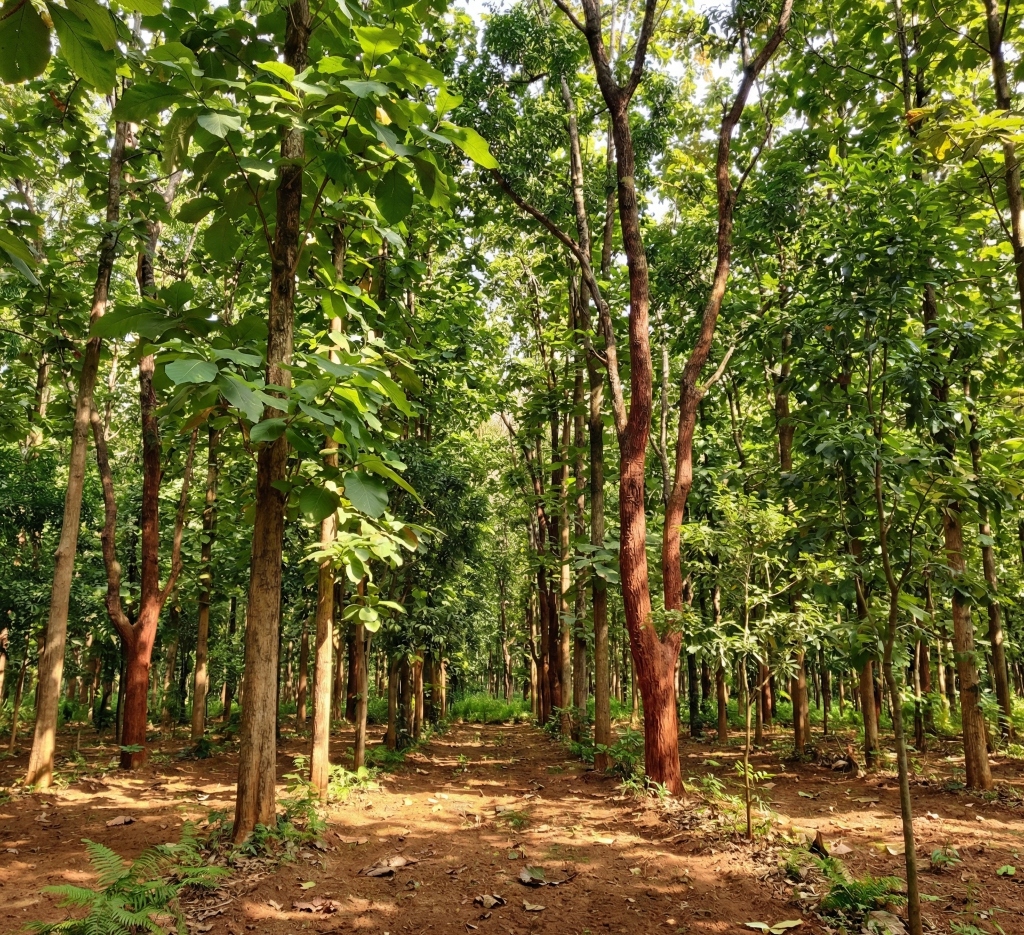
Sandalwood Farming in Bangalore
Secure rare, government-sanctioned Indian sandalwood trees on managed plantation land near Bangalore. One of India's most valuable agrarian assets—fully managed for you.
Why Sandalwood Is Called White Gold
Indian sandalwood (Santalum album) is one of the most valuable trees on earth. Its aromatic heartwood contains pure santalol oil, used in perfumes, cosmetics, pharmaceuticals, and religious ceremonies worldwide.
With global demand far exceeding legal supply, sandalwood prices have risen over the past decade.
Rising Long-Term Demand
Global demand far exceeds legal supply.
Government Sanctioned
Tree Patta scheme grants full legal ownership of cultivated sandalwood.
Passive Management
We handle host tree planting, irrigation, security, and harvest logistics.
A Plantation for the Next Generation
A 20-year plantation that can pass to the next generation.
The White Gold of Deccan
Sandalwood (Santalum album) is one of the most valuable trees in the world. Native to the Deccan plateau, Indian sandalwood commands prices that rival precious metals—making it one of the most compelling long-term agrarian investments available today.
Why Sandalwood Commands Premium Prices
The aromatic heartwood of the sandalwood tree contains pure santalol oil, which is used extensively in perfumes, cosmetics, pharmaceuticals, and religious ceremonies. A single mature sandalwood tree can be worth Rs 50,000 to Rs 3,00,000 depending on its age, heartwood content, and oil concentration.
A Bio-Asset That Compounds Over Decades
Unlike seasonal crops that must be replanted and reinvested annually, sandalwood is a true long-term holding. The tree reaches harvestable maturity at 15-25 years, and its value increases exponentially as the heartwood deepens with age.
Host Tree Symbiosis
One of the most fascinating aspects of sandalwood cultivation is its hemiparasitic nature. Sandalwood cannot survive on its own—it requires a host tree to draw supplementary nutrients from through specialized root connections called haustoria.
The Host Tree Partnership
For our managed sandalwood plantations near Bangalore, we plant nitrogen-fixing host species like Pongamia pinnata (Karanji) or Casuarina equisetifolia between sandalwood saplings. This relationship is mutually beneficial: the host tree provides minerals and water, while the sandalwood's extensive root system helps aerate the soil and improve water retention. Our agronomists carefully manage the spacing and species ratio to optimize growth rates while maximizing heartwood yield potential.
Minimum 15-Year Growth Cycle
The sandalwood tree grows relatively slowly in its first five years, channeling most of its energy into root establishment and establishing the host tree relationship. After year 5-7, visible growth accelerates dramatically. The heartwood formation begins in earnest around year 10-12, and the oil concentration in the heartwood peaks between 15-25 years.
Why The One Acre Farms' Sandalwood Model
Not all sandalwood investments are equal. Our managed plantation model eliminates the operational complexity while maximizing heartwood yield potential through proven agronomic protocols.
Scientific Host Tree Management
We don't plant sandalwood in isolation. Our agronomists carefully design host tree ratios and species selection to maximize the parasitic relationship—ensuring faster growth and higher oil content in the heartwood.
Drip Irrigation Optimized for Sandalwood
Unlike coconut or fruit trees, sandalwood has specific water requirements that must be calibrated carefully. Our automated drip systems deliver precise moisture levels directly to the root zone, promoting deep heartwood formation.
24/7 Security Infrastructure
Sandalwood theft is a serious concern. Our estates feature perimeter fencing, CCTV monitoring, and on-ground security personnel—protecting your investment from the moment saplings are planted.
Why Bangalore's Hinterland Is Ideal
Not all regions of South India are equally suited for commercial sandalwood cultivation. The Deccan plateau around Bangalore—with its red loamy soil, semi-arid climate, and established forestry history—provides good conditions for sandalwood plantations.
Climate & Soil Requirements
Sandalwood thrives in regions with 500-1,000mm of annual rainfall, dry winters, and well-drained soil with a pH between 6.0 and 8.0. The Kanakapura, Thalli, and Devanahalli corridors offer precisely this microclimate. The red laterite soil of these areas drains well, preventing root rot while maintaining sufficient moisture retention for the tree's parasitic root system.
Altitude Advantage
Sandalwood grows best at elevations between 300-1,500 meters above sea level. The elevated plains surrounding Bangalore—particularly the Kanakapura and Devanahalli directions—fall squarely within this ideal range. This altitude creates a natural temperature gradient that promotes slow, even growth and high oil content in the heartwood.
Government of India Tree Patta Scheme
Indian sandalwood is classified as a Minor Forest Produce under the Forest Department. Under the Tree Patta scheme, farmers can legally cultivate sandalwood on their private land for commercial purposes. This provides a fully legal, government-sanctioned pathway to own and harvest sandalwood—making it one of the most legitimate high-value agrarian assets in India.
Turnkey Sandalwood Estate Management
Cultivating sandalwood is not a set-and-forget investment. The trees require careful monitoring, precise irrigation, host tree management, and protection from grazing and theft.
What We Handle
From sapling selection (certified high-oil-content varieties) to planting host trees in the correct ratios, from installing drip irrigation calibrated to the sandalwood's water needs to conducting regular health monitoring—our field teams manage the complete agrarian lifecycle. We also handle security arrangements, including perimeter fencing and 24/7 CCTV monitoring, to protect your investment from theft.
Annual Ownership Reports
Unlike passive farmland investments where you receive little visibility into what's happening on your plot, The One Acre Farms provides comprehensive annual reports for your sandalwood estate. These include tree health assessments, height and girth measurements, heartwood development estimates, and market valuation updates based on current sandalwood price indices.

Managed Sandalwood Estates Near Bangalore
See managed planting up close on a farm visit. Our team runs the day-to-day work while you are in the city.
Sandalwood Farming FAQs
Is sandalwood farming profitable near Bangalore?
Yes, sandalwood farming near Bangalore can be highly profitable due to premium heartwood prices (Rs 5,000–25,000 per kg) and strong demand from perfume, pharmaceutical, and religious industries. A mature tree yields 15-20 kg heartwood worth Rs 75,000–3,00,000. At 60-80 trees per acre, potential asset value at 20-year maturity ranges from Rs 30 lakhs to Rs 2.4 crores per acre.
How long does sandalwood take to mature in Karnataka?
Indian sandalwood reaches harvestable maturity in 15–25 years in Karnataka's Deccan plateau climate. The first 5–7 years focus on root establishment and host tree symbiosis; visible growth accelerates after year 7, with significant heartwood formation beginning around years 10–12. Extending the hold period beyond 20 years further increases heartwood weight and oil content.
What is the investment required for sandalwood farming on 1 acre?
Initial investment for a managed sandalwood plantation on 1 acre near Bangalore ranges from Rs 15–25 lakhs. This includes land preparation, saplings, host trees, drip irrigation, security fencing, and 5 years of agronomic management. Additional annual costs for maintenance (irrigation, security, pruning) are typically Rs 30,000–50,000 per acre until harvest.
Can I grow sandalwood on managed farmland near Bangalore?
Yes, sandalwood thrives on managed farmland in the Kanakapura, Thalli, and Devanahalli corridors near Bangalore. These areas offer the semi-arid climate (500–1,000 mm annual rainfall, dry winters, elevations 300–1,500 m) that sandalwood requires. Managed farmland provides host trees, drip irrigation, security, and harvest logistics—eliminating operational complexity for investors.
What are the legal requirements for sandalwood cultivation in Karnataka?
Legal requirements include obtaining a Tree Patta from the Karnataka Forest Department, which grants ownership of cultivated sandalwood trees on private land. Trees must be registered with the department; harvest requires official inspection and certification. Eligibility depends on your situation; our team walks you through it on a call.
Is sandalwood farming legal in India?
Yes, private cultivation of Indian sandalwood (Santalum album) is legal under the Tree Patta scheme administered by the Forest Department. Unlike wild harvesting, Tree Patta grants you legal ownership of cultivated sandalwood trees on your private land. The trees are registered with the Forest Department, and harvest requires their inspection and certification.
What is the current price of sandalwood in India?
Indian sandalwood heartwood commands Rs 5,000 to Rs 25,000 per kilogram depending on oil content, age, and market conditions. A mature sandalwood tree with 15-20kg of heartwood can be worth Rs 75,000 to Rs 3,00,000. Prices have risen over the past decade due to increasing global demand and supply constraints.
How long does sandalwood take to grow?
Sandalwood is a slow-growing tree that reaches harvestable maturity in 15-25 years. The first 5-7 years are dedicated to root establishment and host tree symbiosis. Visible growth accelerates after year 7, and significant heartwood formation begins around years 10-12. The longer you hold, the more valuable the tree becomes.
What is the ideal climate for sandalwood farming near Bangalore?
Sandalwood thrives in the semi-arid Deccan plateau with 500-1,000mm annual rainfall, dry winters, and elevations between 300-1,500 meters. The Kanakapura, Thalli, and Devanahalli corridors provide these exact conditions—making them ideal locations for commercial sandalwood cultivation near Bangalore.
Does sandalwood require a host tree?
Yes, sandalwood is a hemiparasite and cannot survive without a host tree. It uses specialized root structures called haustoria to draw water and nutrients from neighboring trees. We plant Pongamia pinnata (Karanji) or Casuarina as host trees at specific ratios alongside every sandalwood sapling. This is critical for successful cultivation and maximum heartwood yield.
What income can a sandalwood plantation generate?
While sandalwood is a long-term hold (not a seasonal crop), a single mature tree can be worth Rs 50,000 to Rs 3,00,000 at harvest.
Is sandalwood farming a good investment compared to coconut?
Both serve different portfolio purposes. Coconut plantations start yielding in 4-7 years and provide regular annual income (Rs 30,000-60,000/year/acre). Many investors choose both—coconut for near-term cash flow, sandalwood for long-term capital accumulation.
From the Blog
Sandalwood & Managed Farming Deep Dives
Sandalwood Cultivation: A Profitable Guide for Bangalore Farmers
Growth timelines, spacing, water requirements, and harvest yields explained.
Sandalwood vs Mango Farming Returns at Thalli
Side-by-side comparison of the two most popular crops on OAF farms.
Carbon Credits & Green Revenue for Farm Owners
How sandalwood and timber farms can generate income from carbon sequestration.
Ready to Invest in Rare Sandalwood Assets?
Speak with our team to understand Tree Patta eligibility, plot availability, and projected returns on our managed sandalwood estates near Bangalore.
Finding farms that match...