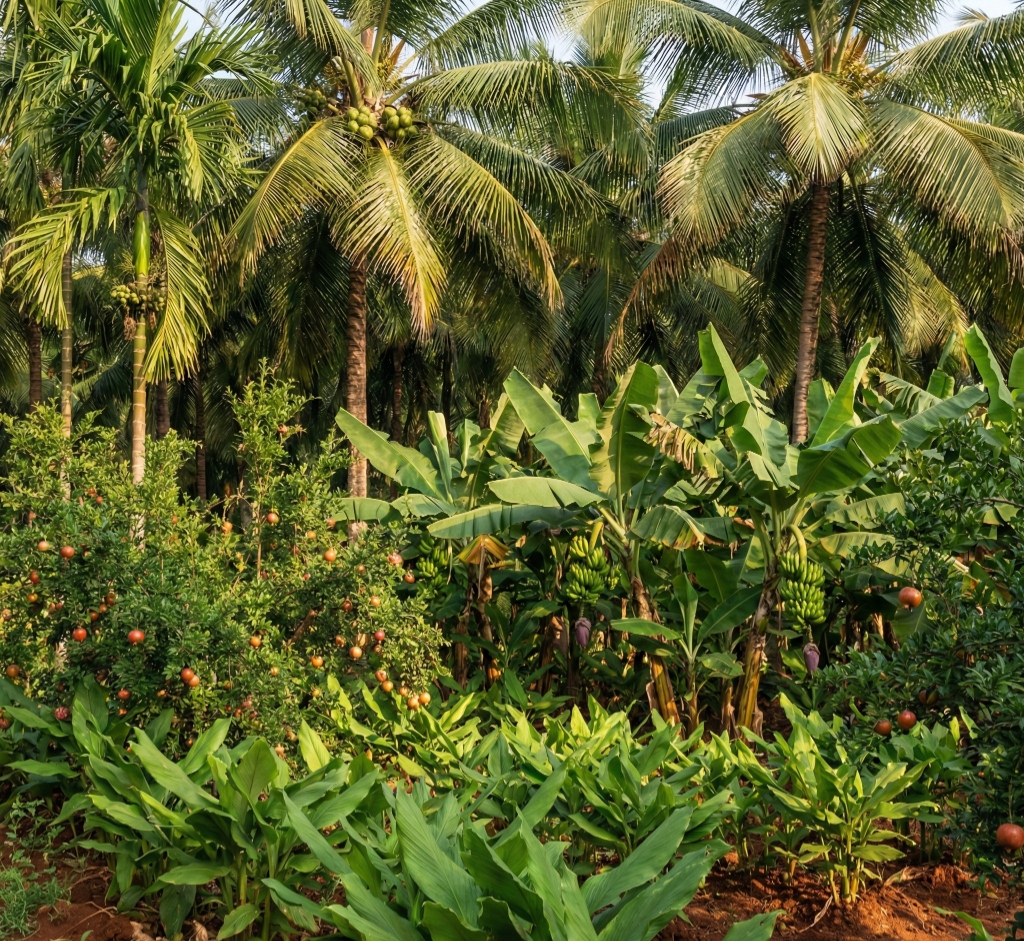
Managed Coconut Plantations Near Bangalore
Own land planted with coconut palms, managed by our farm team, with room for the family on weekends.
Why Coconuts Are Liquid Gold
Investing in a managed coconut plantation is one of the safest agrarian models available in India. The "Tree of Life" provides consistent, year-round yields that scale with inflation.
Unlike seasonal crops that require intensive replanting, a well-managed coconut palm yields for 60 to 80 years.
Steady Multi-Decade Income
Yields multiple harvests annually, providing regular agrarian payouts.
Low Volatility
Coconut demand (water, copra, oil) is inelastic and inflation-resistant.
Passive Management
The One Acre Farms handles all drip-irrigation, fertilization, and harvesting.
Dual Returns
A share of the coconut harvest from land you own.
The Mathematics of Coconut Yields
When evaluating agrarian assets, coconut plantations stand distinct from traditional cash crops. The coconut palm, often called the "Tree of Life," is an exceptionally resilient asset that behaves more like a multi-decade annuity than a seasonal harvest.
The Inflation Hedge
Consider the life cycle: after reaching maturity (typically around year 5-7), a healthy hybrid or tall variety palm will yield anywhere from 80 to 150 nuts annually. Because the palm has a productive lifespan of 60 to 80 years, your initial soil investment pays out dividends literally for three generations.
More importantly, coconut yields are an aggressive hedge against inflation. The commercial demand for coconut derivatives—ranging from tender coconut water to cold-pressed oil, copra, and coir for industrial use—is highly inelastic. As general inflation rises, the wholesale market price of your harvest rises proportionally, ensuring your purchasing power is perfectly protected over the decades.
A Harvest Every Season
It is critical to remember that under Section 10(1) of the Indian Income Tax Act, revenue generated from agricultural activities—including the sale of plantation coconuts—is entirely tax-exempt.
The Water Table Reality
The single greatest risk to any coconut plantation in South India is not pests or market volatility; it is water scarcity. Coconuts are highly water-intensive palms, requiring consistent deep-root hydration to maintain high yields.
Why We Avoid 'Dry' Corridors
Many developers sell "coconut farms" in dry belts of Karnataka where the water table has plummeted past 1,200 feet. In these regions, the palms survive through intensive borewell extraction. However, in low-rainfall years, these borewells fail, leading to catastrophic yield drops or complete crop mortality.
At The One Acre Farms, our site selection methodology strictly filters out high-stress water zones. We locate our plantation projects primarily in the border regions (like Thalli/Denkanikottai) which benefit from higher elevations, the Arkavathy basin spillover, and significantly healthier static water levels.
Drip Irrigation & Contour Trenching
Even in water-secure zones, we do not rely on traditional flood irrigation. We implement Israeli-standard automated drip irrigation grids connected to massive gravity-fed percolation ponds. By combining deep contour trenching with mulching techniques using coconut fronds, we reduce the plantation's water evaporation by up to 40%. When you buy into our estates, you are buying a hydro-logically engineered asset, not just trees in the dirt.

Managed Plantations Near Bangalore
Our agronomy team plants and looks after the trees while you are in the city. Visit and walk the rows yourself.
The One Acre Advantage
Many investors evaluating operators like Sanjeevani Farms ultimately choose The One Acre Farms. Here is the operational philosophy that sets our plantations apart.
No "Frills", Highly Capital Efficient
We don't build massive, expensive clubhouse infrastructure that drains your recurring maintenance fees.
Intercropping Mastery
A pure monoculture plantation is vulnerable. We practice strategic intercropping—planting Timber (Teak/Sandalwood), Mango, or Guava between coconut palms to maximize yield per square foot.
Boutique, Low-Density Estates
Unlike mega-developments where you are one among thousands, our estates stay small, so the farm team knows every plot and every owner.
Beyond Monoculture
Many traditional plantations fail because they rely solely on a single crop—coconuts. If diseases like Root (Wilt) or pest attacks hit the palm canopy, the entire farm's revenue drops to zero for multiple years.
The 4-Layer Planting Plan
The One Acre Farms mitigating this risk entirely by employing strategic intercropping methodologies. Coconuts require massive spacing (typically 25 to 30 feet between palms) to allow their fronds to expand. This leaves roughly 60% of your acre's surface area completely unused in a monoculture setup.
Our agronomists utilize this space by layering high-value crops with varying heights and root depths. Beneath the towering coconut canopy (Layer 1), we plant mid-height fruit trees like Banana, Papaya, and Guava (Layer 2). At the ground level, we cultivate shade-tolerant cash crops like Turmeric, Ginger, or Pepper vines climbing the palm trunks (Layer 3).
Compounding Yields
This multi-tiered system ensures that even if one crop experiences a poor season due to weather anomalies, the other layers provide a secure financial baseline. Furthermore, the symbiotic relationship between these plants naturally suppresses weeds, reduces soil erosion, and organically fixes nitrogen, significantly lowering input fertilizer costs.
When you invest in our managed estates, you aren't just buying coconuts; you are acquiring a structurally diverse, robust agroforestry engine.
A Turnkey, No-Frills Operation
The harsh reality of farm ownership is that agriculture is labor-intensive. For an urban professional or a busy tech executive, managing laborers, sourcing genuine fertilizers, and negotiating with local wholesale buyers is impossible.
The End-to-End Agronomy Desk
The One Acre Farms removes this friction entirely by operating an in-house, dedicated Agronomy and Operations desk. When you purchase a managed plantation plot, our field managers handle 100% of the agrarian lifecycle. We deploy permanent farming staff, monitor security via CCTV and on-ground personnel, implement precise drip irrigation schedules, and most importantly, handle the harvest logistics.
Transparent Monetization
We do not leave you to sell your own coconuts. At harvest time, our operations team consolidates the yield from the entire estate, granting us bulk negotiating leverage with commercial buyers, tender coconut vendors, and oil extractors. The proceeds from these bulk sales are then transparently distributed to the plot owners on a pro-rata or per-tree basis.
By stripping out the expensive "resort" amenities that plague our competitors, we ensure that your maintenance fees are directed entirely toward what matters: soil health, tree vitality, and security. We do the heavy lifting.
Plantation FAQs
Is investing in a coconut plantation profitable?
Mature coconut palms bear for decades, and you get a share of the harvest. Ask your CA how harvest income is taxed in your case.
How is The One Acre Farms different from Sanjeevani Farms?
The One Acre Farms focuses on premium, low-density rural luxury.
Who manages the plantation after I buy?
The One Acre Farms provides end-to-end agrarian management. We deploy agronomists, handle drip irrigation, security, harvesting, and market the produce, sharing the yields with the plot owners.
How many coconut trees can be planted on one acre of farmland?
A typical coconut farm plants 45-60 trees per acre at a spacing of approximately 25ft x 25ft. Spacing may vary based on variety (tall vs dwarf), soil quality, and whether inter-cropping is practiced. Our farm managers optimize density for maximum yield per acre.
How long before coconut trees start yielding?
Dwarf and hybrid coconut varieties begin yielding in 3-4 years after planting. Tall varieties (the most common for commercial plantations) typically start producing in 6-8 years. Once mature, a healthy coconut palm can yield 60-150 nuts per year for 60+ years.
What is the annual income from a one-acre coconut plantation?
A well-managed one-acre coconut plantation near Bangalore can generate Rs 30,000-60,000 per year in agricultural income from nut sales alone. Additional income comes from coir, coconut water tourism, and intercropping.
Do coconut farms require a lot of water?
Coconut palms require consistent moisture but are relatively drought-tolerant once established. A drip irrigation system delivering 60-80 litres per palm per day is sufficient in non-monsoon months. Our managed farms use borewell water + rain-fed farm ponds to ensure year-round irrigation without strain on groundwater.
Can non-agriculturists buy coconut farmland near Bangalore?
Eligibility depends on your situation; our team walks you through it on a call. See /legal-guide-buying-farmland-karnataka-tamil-nadu.
Explore More
Ready to Secure Your Agrarian Asset?
Speak with our team to understand the yields, legal structure, and availability of our current plantation plots near Bangalore.
Finding farms that match...