If you have spent any time researching farmland near Bangalore, you have probably heard conflicting things: "Only farmers can buy agricultural land in Karnataka" or "The rules changed recently" or "79A means you cannot buy." Most of this information is outdated or outright wrong.
This guide is written for 2026. It covers what actually changed, what the current law says, what documents you still need, what land conversion involves, and what the proposed 79A/79B reinstatement means for your purchase plans. Everything here is based on the Karnataka Land Reforms Act, the 2020 and 2025 amendments, and the current regulatory landscape as of May 2026.
- The 2020 repeal of Sections 79A, 79B, and 79C — what it means for buyers
- Who can buy agricultural land in Karnataka right now (2026)
- What documents are still required despite the rule change
- DC conversion: when and why you need it, and 2025 amendments
- 79A/79B reinstatement debate — current status
- Freshness-corrected misinformation circulating in 2026
Myth vs. Reality
"You need to be a farmer or have agricultural income to buy land in Karnataka."
"IT professionals and salaried employees cannot buy farmland near Bangalore."
"You can build a farmhouse on agricultural land without DC conversion."
1. What Changed: The 2020 Karnataka Land Reforms Amendment
On 13 July 2020, the Government of Karnataka promulgated Ordinance No. 13 of 2020, which received assent as the Karnataka Land Reforms (Amendment) Act, 2020 on 28 September 2020. This was the most significant change to Karnataka's agricultural land ownership rules in six decades.
The amendment did three things:
- Repealed Sections 79A, 79B, and 79C entirely. Section 79A previously barred individuals with non-agricultural income exceeding Rs 25 lakh per year from buying agricultural land. Section 79B barred companies, trusts, educational institutions, and societies from holding agricultural land. Section 79C dealt with penalties for falsely claiming agriculturist status. All three are gone.
- Raised the land ceiling. Under Section 63, the ceiling for individuals and families of up to 4 members increased from 10 units to 20 units. Families with 5+ members can hold up to 40 units. (1 unit = approximately 1.33 acres in dry zone areas.)
- Added SC/ST protections (Section 80-A). Agricultural land held by SC/ST members cannot be transferred to non-SC/ST buyers without government permission under the Karnataka Prevention of Alienation of Certain Lands Act.
Approximately 13,814 pending forfeiture cases under the old 79A/79B provisions were dismissed.
2. What Changed When: Timeline of Karnataka Land Law
| Year | Event | Impact on Buyers |
|---|---|---|
| 1961 | Karnataka Land Reforms Act enacted | Established ceiling limits, tenant protections, and restrictions on non-agriculturist land ownership |
| 1995 | Section 79A income limit raised to Rs 2 lakh | Moderately expanded eligibility — most middle-class buyers still excluded |
| 2015 | Income limit raised to Rs 25 lakh under Section 79A | Higher-income professionals could buy, but companies and trusts still barred |
| July 2020 | Sections 79A, 79B, 79C repealed by Ordinance | Any Indian citizen can now buy agricultural land in Karnataka — no income or agriculturist status requirements |
| Sept 2020 | Ordinance receives Governor's assent | Repeal becomes permanent law; 13,814 pending forfeiture cases dismissed |
| Aug 2024 | CM Siddaramaiah announces intent to restore 79A/79B | No legislation passed yet — creates market uncertainty but does not change current law |
| 2025 | Karnataka Land Revenue (Amendment) Rules, 2025 | DC exemption expanded to 4 hectares; industrial use of up to 2 acres without conversion; penalty reduced from criminal to civil |
| May 2026 | Current status: 79A/79B remain repealed | No restoration bill enacted — any Indian citizen can still freely purchase agricultural land |
3. Who Can Buy Agricultural Land in Karnataka Now (2026)
As of May 2026, the following categories of persons can purchase agricultural land in Karnataka:
- Any Indian citizen — regardless of whether they have agricultural income, farming experience, or rural background. IT professionals, business owners, salaried employees — all eligible.
- Companies, trusts, and societies — the 79B restriction on corporate and institutional buyers is repealed. Private limited companies, Section 8 companies, and charitable trusts can all purchase agricultural land.
- Non-resident Indians (NRIs) and Overseas Citizens of India (OCIs) — cannot directly purchase agricultural land under FEMA regulations. This is a central (not state) restriction and applies regardless of the 79A/79B repeal. NRIs can inherit agricultural land or hold it through a resident Indian family member with proper Power of Attorney. For the full breakdown, see our NRI farmland investment guide.
What Has Not Changed
- 1. DC conversion is still required for any non-agricultural use (residential, commercial, industrial)
- 2. SC/ST land protections (Section 80-A) remain fully in effect
- 3. Land ceiling limits still apply — 20 units for a family of 4 (roughly 26 acres in dry zone)
- 4. Class A irrigated land restrictions remain — government-irrigated land stays agricultural-use only
- 5. FEMA restrictions on NRI purchases apply nationwide — separate from state-level rules
4. Documents You Still Need to Buy Agricultural Land
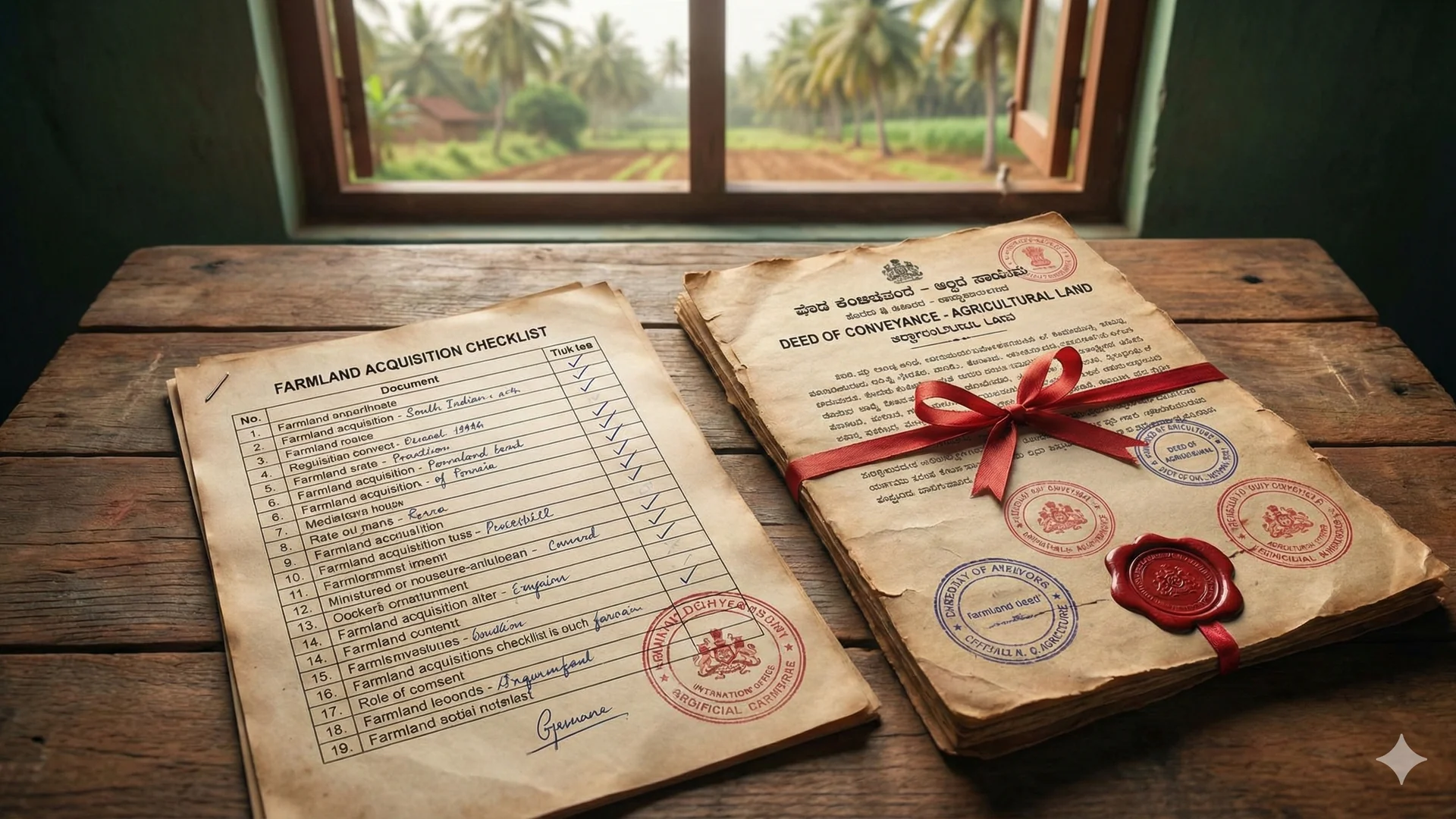
The 79A/79B repeal removed the eligibility barrier, but it did not remove the documentation requirement. You still need a thorough set of documents to register and protect your ownership. Skipping any of these can leave you exposed to title disputes, classification errors, or enforcement action.
- RTC (Record of Rights, Tenancy and Crops) — The single most important document. Available on the Bhoomi portal (landrecords.karnataka.gov.in). Confirms current ownership, land classification (agricultural, dry, wet), and any tenancy or encumbrance.
- Encumbrance Certificate (EC) — 30 years — Shows every registered transaction: sales, mortgages, gifts, court orders. Get this from the Sub-Registrar's office or online through Kaveri portal. If the EC has gaps, treat it as a red flag.
- Mutation Extract — The revenue department's record of ownership transfer. Confirms that the seller's name appears in the revenue records. Must match the RTC.
- Mother Deed / Title Deed Chain — Traces ownership back at least 30 years. Every transfer in the chain must be accounted for. Missing links in this chain are the most common source of title disputes.
- Survey Sketch (11E Sketch) — Maps the exact boundaries of the land. Compare this against the physical boundaries on site. Mismatches between the sketch and the RTC area are a warning sign.
- Revenue Map and Tippani — Shows survey numbers, boundaries, and any government reservations or classifications that affect the land.
- Family Tree / Family Member Certificate — Establishes that the seller has sole right to sell, or that all co-owners have consented. Especially important for inherited properties.
For a complete document-by-document verification walkthrough, see our guide to understanding RTC, EC, and farmland documentation.
5. DC Conversion: What It Is and 2025 Amendments
Buying agricultural land gives you the right to own agricultural land. It does not give you the right to build on it, start a business on it, or use it for any non-agricultural purpose. For that, you need DC (Deputy Commissioner) conversion under Section 95 of the Karnataka Land Revenue Act, 1964.
DC conversion involves:
- Applying to the Deputy Commissioner of the district where the land is located
- Providing the RTC, EC, survey sketch, and a site plan
- Paying conversion fees (varies by zone — near Bangalore: Rs 30-80 lakh per acre)
- Receiving a conversion order that changes the land classification from agricultural to residential/commercial/industrial
2025 Amendment: Conversion Changes
The Karnataka Land Revenue (Amendment) Rules, 2025 made three significant changes:
- • DC exemption expanded: From 0.5 hectares to 4 hectares (all districts except Bangalore Rural and BBMP limits). Deputy Commissioners can now approve larger land-use changes without state-level clearance.
- • Industrial use without conversion: Up to 2 acres of agricultural land can be used for new industries without DC conversion, provided the land is for agro-based or food processing industries and is not in a green zone.
- • Penalty reduced: Non-agricultural use without conversion is now a civil fine of Rs 1 lakh — the previous penalty of 3 years imprisonment has been removed entirely.
6. The 79A/79B Reinstatement Debate: Where Things Stand
In August 2024, Chief Minister Siddaramaiah publicly announced the state government's intent to restore Sections 79A and 79B of the Karnataka Land Reforms Act. Proponents argue the 2020 repeal enabled speculative land accumulation, driving agricultural land prices beyond the reach of actual farmers. Opponents counter that the original provisions were corruption-prone (agriculturist certificates were routinely forged) and that DC conversion adequately protects agricultural land from non-agricultural misuse.
As of May 2026, no bill restoring 79A or 79B has been passed by the Karnataka legislature or received the Governor's assent. The 2020 framework remains in full effect. Here is what this means in practical terms:
- Current purchases are legal — any Indian citizen buying agricultural land today is fully compliant with current law
- If reinstated, new restrictions would likely be prospective — meaning they would apply to future purchases, not retroactively to land already acquired
- The political debate is ongoing — the same CM who now wants 79A/79B back previously raised the income ceiling in 2015, which critics say favored real estate interests
- Monitor the Karnataka legislature session agendas — any bill would need to pass both houses and receive Governor's assent before becoming law
We recommend consulting a registered legal advisor before making purchasing decisions, especially given this regulatory uncertainty. For a detailed legal walkthrough covering both Karnataka and Tamil Nadu, see our comprehensive farmland buying legal guide.
7. Correcting Common Misinformation (2026)
Social media, WhatsApp forwards, and even some legal consultation websites still cite pre-2020 rules. Here are the most common pieces of outdated information and the current reality:
Misinformation: "You need to be a farmer to buy agricultural land in Karnataka"
This has not been true since October 2020. Sections 79A and 79B — the provisions that restricted non-agriculturists — were repealed. Any Indian citizen can buy agricultural land in Karnataka today.
Misinformation: "79A/79B means IT professionals cannot buy farmland"
79A/79B are repealed — they have no force of law as of May 2026. This restriction does not exist. IT professionals, salaried employees, business owners, and any other Indian citizen can purchase freely.
Misinformation: "You can build a house on agricultural land without conversion"
DC conversion under Section 95 is still required for any non-agricultural use, including residential construction. The 2025 amendment provides limited exemptions for small-scale industrial use only (up to 2 acres for agro-based industries). Residential use still requires conversion.
Accurate: "NRIs still cannot buy agricultural land in Karnataka"
This is correct. The FEMA restriction on NRI agricultural land purchases is a central law and was never affected by the state-level 79A/79B repeal. NRIs can inherit agricultural land or hold it through resident family members, but cannot purchase directly.
Key Takeaways for 2026 Buyers
- 1. 79A/79B is repealed — any Indian citizen can buy agricultural land in Karnataka. No agriculturist certificate or farming income required
- 2. No 79A/79B restoration bill has been enacted as of May 2026. The current legal framework is the 2020 amendment
- 3. Required documents remain the same: RTC, 30-year EC, mutation extract, mother deed, survey sketch, revenue map
- 4. DC conversion is still mandatory for any non-agricultural use (residential, commercial) — the 2025 exemption is for industrial use only
- 5. NRIs cannot purchase directly under FEMA — but can inherit or hold through resident family members
- 6. Always verify SC/ST status of the seller (Section 80-A) and check that the land is not classified as Class A irrigated
Disclaimer: Land laws and regulations vary significantly between states (Karnataka vs. Tamil Nadu) and are subject to frequent amendments. This guide is for informational purposes only and does not constitute legal advice. Always perform independent due diligence through a qualified advocate.
Frequently Asked Questions
79A/79B repealed 2020. Any Indian citizen may purchase. NRIs: FEMA applies. Past performance is not a guarantee of future returns. This is not financial advice. Laws may change — consult a registered legal advisor for your specific situation.
Interested in owning farmland?
Schedule a free site visit to explore our managed farmland projects near Bangalore.