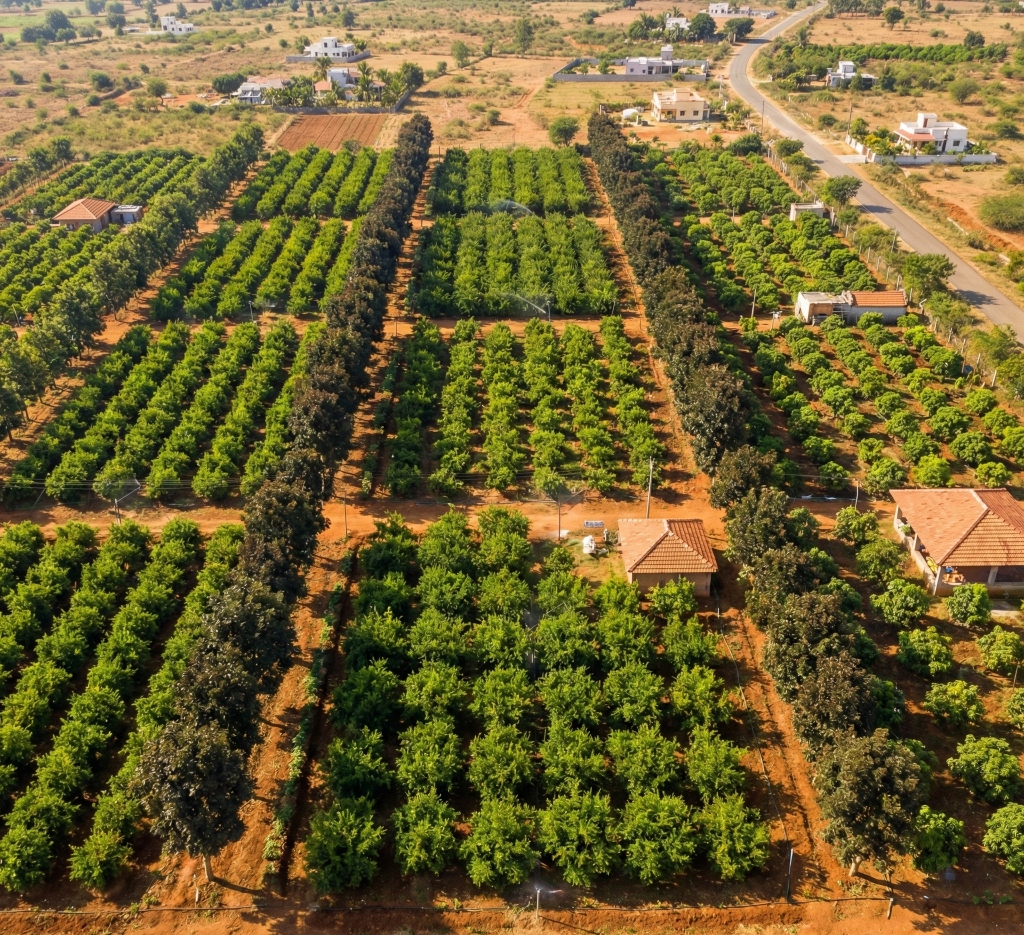
Farmland vs REITs India — Which Investment Wins?
Indian REITs have delivered 10–14% annual returns. Our Hilltop farmland delivered 230% over 7 years — plus tax-free harvest income. But REITs offer daily liquidity. Here is the full honest comparison.
All appreciation figures are based on historical data from completed projects. Past performance is not a guarantee of future returns.
The Numbers Don't Lie
Managed Farmland
7 years (2016–2023)
6 years (2017–2023)
5 years (2018–2023)
3–4 years
130+ co-farmer families across 10+ years
Embassy, Mindspace, Brookfield
Since listing 2019
Since listing 2020
Since listing 2022
Annualised total return
Source: NSE India, REIT annual reports 2019–2024
Farmland vs REITs: Full Comparison
| Metric | Managed Farmland | Indian REITs (NSE) | Advantage |
|---|---|---|---|
| Total Returns (7 Years) | 75–230% over 3–7 years (OAF historical) | ~100–130% total return (10–14% per year avg) | Farm |
| Annual Income | Tax-free harvest sharing (Rs 50K–2L+/yr) | Dividend/distribution taxable at slab rate | Farm |
| Capital Gains Tax | Exempt u/s 54B on agri land sale | STCG 15% / LTCG 10-20% with indexation | Farm |
| Income Tax on Earnings | Exempt u/s 10(1) ITA | Dividend income taxable at slab rate | Farm |
| Ownership | Full title deed — physical land in your name | Units in a trust — no direct land ownership | Farm |
| Liquidity | Lower — 3–6 months to sell | Higher — trade on NSE, T+2 settlement | REIT |
| Minimum Investment | Rs 40–95L (1-acre plot at Thalli, TN) | Rs 200–500 per unit on NSE | REIT |
| Use / Visit | Yes — visit your acre, weekend farmhouse option | No — commercial properties managed by trustee | Farm |
* REIT returns sourced from NSE India and REIT annual reports (Embassy, Mindspace, Brookfield). Farmland returns from OAF completed project sales data.
Why Farmland Wins in 3 Dimensions
Direct Land Ownership
A title deed registered in your name at the sub-registrar office. You own the land outright — not a unit in a trust. You can visit it, build on it (subject to zoning), and pass it to your children directly. REITs are fractional interests in commercial buildings managed by trustees.
Tax-Free Income
Harvest income is exempt from Income Tax under Section 10(1). REITs distribute rental income that is taxable at your slab rate — the trust does not pass through tax benefits. Farmland also qualifies for Section 54B capital gains exemption on sale — REIT unit gains do not.
Tangible Lifestyle
Your acre is a real place — weekend farmhouse option, fresh food, a retreat from city life. REIT units are numbers on a screen. You cannot visit Embassy Office Parks or Mindspace buildings. Farmland gives you both an investment AND a lifestyle asset.
When REITs Make More Sense
REITs are not inferior — they serve different needs. REITs offer daily liquidity on the NSE. You can sell REIT units in seconds during market hours; farmland takes 3–6 months. If you need capital access on demand, REITs are significantly more liquid.
REITs also offer lower minimum investment — you can start with Rs 200–500 per unit. This makes them accessible for investors who cannot commit Rs 40–95 lakhs upfront. REITs are also transparent — listed on NSE with daily price discovery and regulatory reporting.
Many investors use both: REITs for liquidity and farmland for long-term appreciation and passive income. We recommend consulting a financial advisor for your specific allocation between these asset classes.
Who Is Choosing Farmland Over REITs?
Investors who already hold REITs or mutual funds and want tangible alternative assets
Families wanting direct land ownership — a title deed they can see and touch
IT professionals seeking passive agricultural income plus long-term land appreciation
NRIs wanting productive India assets with tax-efficient returns and no management hassle
Investors tired of purely digital portfolios wanting a physical asset to visit
HNI families allocating 10–15% to real alternative assets for portfolio diversification
Why Our Farmland Delivers What REITs Cannot
10+ Years of Operations
Four sold-out projects. 130+ co-farmer families. Proven track record.
Direct Title Deed
Land registered in your name at sub-registrar — not a unit in a trust.
Tax-Free Harvest Income
Annual crop income exempt from Income Tax under Section 10(1).
230% Hilltop Returns
vs Embassy REIT's ~14% per year since listing.
Fully Managed Model
Zero farming knowledge required. We handle everything from sapling to harvest.
Tangible Lifestyle Asset
Your own acre to visit, escape to, and pass to the next generation.
Frequently Asked Questions
Is farmland a better investment than REITs in India?
Over a 7-year horizon, managed farmland has significantly outperformed Indian REITs. Our Hilltop project delivered 230% total appreciation (2016–2023), while Indian REITs have generated approximately 10–14% per year in distributed income and capital appreciation. Farmland also offers direct title deed ownership — you own the land outright. REITs give you units in a trust that holds properties on your behalf. Past performance is not a guarantee of future returns.
What is the key difference in ownership between farmland and REITs?
With farmland from The One Acre Farms, you receive a direct title deed — you own the physical land in your name, registered at the sub-registrar office. With REITs units, you own a fractional interest in a trust that holds income-generating properties. You cannot visit or use REIT properties. You cannot sell just one unit's worth of the underlying land. Direct ownership of physical land is qualitatively different from unit trust ownership.
How do tax benefits compare between farmland and REITs?
Agricultural income from managed farmland is exempt from Income Tax under Section 10(1) of the Income Tax Act, 1961. REITs, however, distribute rental income to unit holders which is taxed at your slab rate — not at the trust level. Capital gains from REIT unit sales attract STCG (15%) or LTCG (10%/20% with indexation) depending on holding period. There is no equivalent tax-free income stream from REIT distributions.
Which is more liquid — farmland or REITs?
REITs are significantly more liquid — they trade on the NSE like stocks, meaning you can buy and sell during market hours with settlement in T+2 days. Farmland takes longer — typically 3–6 months — due to higher ticket size and smaller buyer pool. However, The One Acre Farms maintains an active secondary market through co-farmer referrals and a waitlist, and farmland does not suffer from the market-timing risk that affects REIT unit prices.
What returns can I expect from REITs vs farmland in India?
Indian REITs (like Embassy, Mindspace, Brookfield) have delivered 10–14% per year in total returns since listing, comprising rental income distributions and capital appreciation. Our completed farmland projects: Hilltop 230% (7 years), Lakeside 220% (6 years), Country Side 200% (5 years), Misty Valley 75–150% (3–4 years). Farmland returns are land appreciation only — separate from the harvest income. All appreciation figures are based on historical data from completed projects — past performance is not a guarantee of future returns.
What is the minimum investment for farmland vs REITs?
REIT units on the NSE can be bought for as little as Rs 200–500 per unit, making them accessible for small investors. However, to build meaningful rental income from REITs you need a significant corpus — typically Rs 5–10 lakhs minimum. A 1-acre managed farmland plot near Thalli, Tamil Nadu starts from Rs 40–95 lakhs. Both are accessible at different price points; farmland gives direct land ownership and tax-free income, while REITs offer daily liquidity and NSE transparency.
Disclaimer: All appreciation figures are based on historical data from completed One Acre Farms projects (Hilltop, Lakeside, Country Side, Misty Valley). Past performance is not a guarantee of future returns. REIT performance data sourced from NSE India and REIT annual reports (Embassy REIT, Mindspace REIT, Brookfield REIT). Agricultural income is exempt from Income Tax under Section 10(1) of the Income Tax Act, 1961. Capital gains on agricultural land may be exempt under Section 54B subject to conditions. This is not financial advice — consult a SEBI-registered financial advisor or Chartered Accountant for your specific situation.
Ready to Compare REITs vs Farmland?
Talk to our team. We'll walk you through real farmland returns, actual project visits, and honest advice — no sales pitch, just facts.
Finding farms that match...