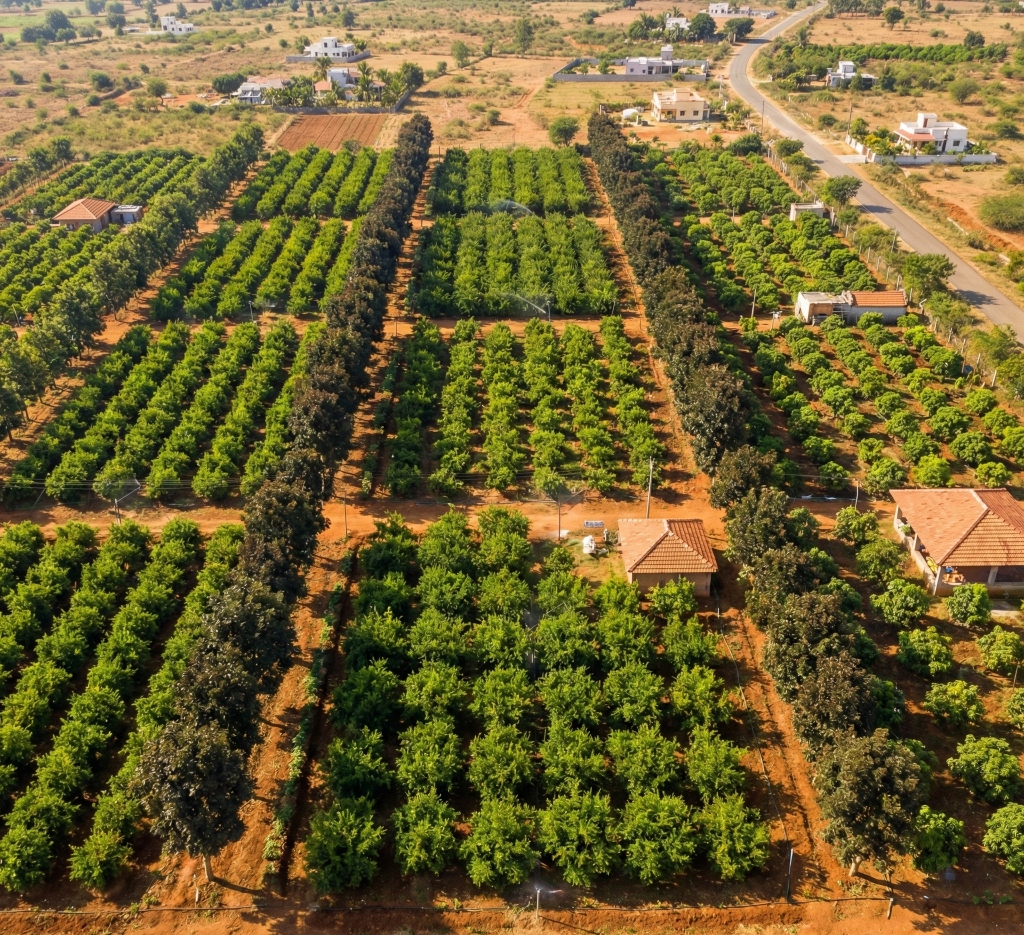
Farmland vs Gold Investment — Which Wins Over 7 Years?
The numbers tell a clear story. Our Hilltop project delivered 230% appreciation over 7 years. Gold returned approximately 85% (CAGR ~9%) in the same period. Farmland also generates tax-free harvest income. Here is the full comparison.
All appreciation figures are based on historical data from completed projects. Past performance is not a guarantee of future returns.
The Numbers Don't Lie
Managed Farmland
7 years (2016–2023)
6 years (2017–2023)
5 years (2018–2023)
3–4 years
130+ co-farmer families across 10+ years
24K Gold / Gold ETF
CAGR ~9%
CAGR ~8%
CAGR ~10%
Post-COVID rally
Source: MCX India, World Gold Council price data
Farmland vs Gold: Full Comparison
| Metric | Managed Farmland | Gold (24K / ETF) | Advantage |
|---|---|---|---|
| Historical Returns (7 Years) | 75–230% over 3–7 years (OAF verified) | 85% over 7 years (CAGR ~9%) | Farm |
| Annual Income | Tax-free harvest sharing (Rs 50K–2L+/yr) | Zero — no yield unless rented | Farm |
| Capital Gains Tax | Exempt u/s 54B on agri land sale | LTCG 20% with indexation after 3 years | Farm |
| Income Tax on Earnings | Exempt u/s 10(1) ITA | No recurring income to tax | Farm |
| Purchase Tax / GST | Stamp duty applicable (7–9% in TN) | 3% GST on purchase | — |
| Tangibility | Physical asset with productive use | Physical or digital, no productive income | Farm |
| Liquidity | Lower — 3–6 months to sell | Higher — immediate (digital) or 1–3 days (physical) | Gold |
| Effort Required | Zero — fully managed by OAF team | Zero — stored and forgotten | — |
* Gold price data sourced from MCX India and World Gold Council. Farmland returns from OAF completed project sales data.
Why Farmland Wins in 3 Dimensions
Total Return
130–230% appreciation vs 85%. Tax-free harvest income. Exempt capital gains on sale. Farmland works on three financial levers simultaneously — gold only tracks inflation as a store of value.
Passive Income
Farmland generates Rs 50,000–2,00,000+ per year in tax-free harvest sharing. Gold generates nothing unless rented out (rare and impractical for most investors). Income matters more as you approach retirement.
Tangible Asset
Your acre is a real place you can visit, escape to, and pass on to your children. Gold is anonymous, fungible, and purely a number in a vault or demat account. Tangibility has psychological and generational value.
When Gold Makes More Sense
Gold is not inferior — it is different. Gold is more liquid than farmland. If you need capital access within days, gold (especially digital gold or gold ETFs) can be sold instantly. Farmland requires 3–6 months in a normal market.
Gold is also a better crisis hedge. In market crashes, wars, or currency crises, gold holds its value or spikes. Farmland can be affected by severe droughts, floods, or policy changes. Both are good hedges against ordinary inflation — gold is a better hedge against systemic financial risk.
If your investment horizon is less than 3 years, gold may be more appropriate. If you are investing for 5–10 years and want both appreciation and passive income, farmland from a proven developer significantly outperforms.
Who Is Choosing Farmland Over Gold?
Senior IT professionals (35–55) who already hold gold as traditional family wealth
Families wanting a tangible asset they can visit, use, and pass to the next generation
Investors tired of gold's zero yield — wanting income plus appreciation
NRIs looking for productive India assets with tax-efficient returns
Early retirees who want agricultural income and a rural lifestyle option
HNI families allocating alternative assets for portfolio diversification
Why Our Farmland Delivers What Gold Cannot
10+ Years of Operations
Four sold-out projects. 130+ co-farmer families. Proven track record.
Tax-Free Harvest Income
Annual crop income exempt from Income Tax under Section 10(1). Gold has no yield.
Fully Managed Model
Zero farming knowledge required. We handle everything from sapling to harvest.
Capital Appreciation
230% Hilltop returns vs gold's ~85% over the same period.
Tangible Ownership
Your own acre to visit, escape to, and inherit. Gold is fungible and anonymous.
Thalli–Hosur Corridor
15 km from Hosur. 900m elevation. 45–55 km from Electronic City.
Frequently Asked Questions
Is farmland a better investment than gold in India?
Over 7 years, managed farmland near Bangalore has significantly outperformed gold. Our Hilltop project delivered 230% appreciation (2016–2023), while gold returned approximately 85% over the same period (CAGR ~9%). Farmland also generates tax-free agricultural income, while gold gains attract capital gains tax. Past performance is not a guarantee of future returns.
What are the tax benefits of farmland vs gold investment?
Agricultural income from managed farmland is exempt from Income Tax under Section 10(1) of the Income Tax Act, 1961. Gold, however, attracts a 3% GST on purchase, and long-term capital gains tax of 20% with indexation when sold after 3 years. There is no equivalent tax-free income stream from gold.
Does farmland produce income like gold does not?
Yes. Managed farmland produces annual crop income — through harvest sharing — that is tax-free under Section 10(1). A 1-acre managed plot can generate Rs 50,000–2,00,000+ per year depending on crops (silvopasture, mango, sandalwood). Gold produces no income unless rented out (uncommon for physical gold) — it only appreciate as a store of value.
Which is more liquid — farmland or gold?
Gold is significantly more liquid. Digital gold can be sold instantly through apps like Groww or Paytm; physical gold takes 1–3 days to sell at a jeweller. Farmland takes longer — typically 3–6 months — due to higher ticket size and smaller buyer pool. However, The One Acre Farms maintains an active secondary market through co-farmer referrals and a waitlist.
What are the inflation-hedging properties of farmland vs gold?
Both gold and farmland are traditional inflation hedges in India, but they work differently. Gold is a store of value that tracks inflation over long periods — its price roughly doubled from 2016 to 2023. Farmland appreciation has significantly outpaced inflation in the corridors we operate (Thalli–Hosur), driven by urban expansion and infrastructure development, not just inflation indexing. Farmland also generates real income during inflationary periods, while gold does not.
Can I hold farmland and gold together in my investment portfolio?
Yes — gold and farmland serve different portfolio functions. Gold provides liquidity and acts as a crisis hedge; farmland provides capital appreciation, passive income, and tangible ownership of a productive asset. Many of our co-farmers already hold gold as part of their broader portfolio and add farmland for income generation and long-term appreciation. We recommend consulting a financial advisor for your specific allocation.
Disclaimer: All appreciation figures are based on historical data from completed One Acre Farms projects (Hilltop, Lakeside, Country Side, Misty Valley). Past performance is not a guarantee of future returns. Gold price data sourced from MCX India and World Gold Council. Agricultural income is exempt from Income Tax under Section 10(1) of the Income Tax Act, 1961. Capital gains on agricultural land may be exempt under Section 54B subject to conditions. This is not financial advice — consult a SEBI-registered financial advisor or Chartered Accountant for your specific situation.
Ready to Diversify Beyond Gold?
Talk to our team. We'll walk you through real farmland returns, actual project visits, and honest advice — no sales pitch, just facts.
Finding farms that match...