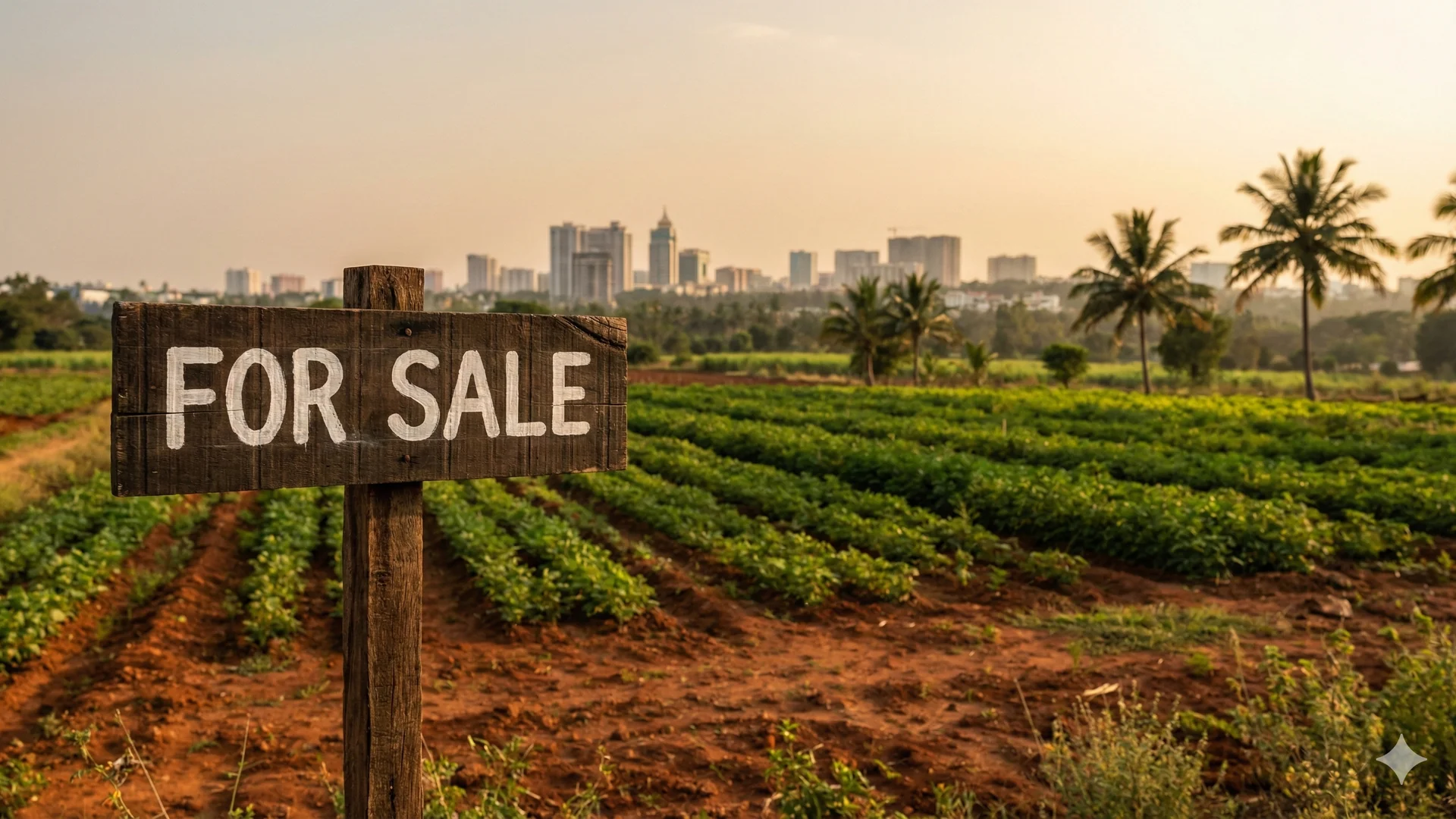
The ₹5-lakh acre near Bangalore is not a bargain. It is a business model — and you are not the customer. You are the revenue.
What follows is a story we have heard, in different costumes, from dozens of people who eventually called us. The names and details are changed and combined; the mechanics are exactly as buyers describe them to us, week after week.
Saturday one: the ₹4.5-lakh acre
Suresh is a delivery manager at a company in Bellandur. Two EMIs, one daughter, and a browser folder called FARM DREAM. One night a YouTube thumbnail finds him: "1 ACRE ₹4.5 LAKHS ONLY!! 40 km from Bangalore, red soil, borewell point available." The video has a man in a white shirt walking through green fields, a phone number in the description, and four hundred comments asking "location please sir."
Suresh calls. The broker is warm, unhurried, reassuring. Yes sir, land is available. Good land, many buyers asking. One thing only — "so many time-pass people are calling, sir. Transfer ₹3,000 for the site visit. This is so we know you are a serious buyer. It covers my time and petrol also. Fully adjustable in the final price."
Fully adjustable in the final price. It sounds almost reasonable. ₹3,000 against a ₹4.5-lakh acre? Suresh transfers it before his wife can ask a question he cannot answer.
The tour
Saturday morning, Suresh drives out, pays for the broker's breakfast — "we will go in your car only, sir" — and is taken to see the land. Three parcels, as it turns out:
- Parcel one has no road. The car stops at the edge of a village track and they walk seven hundred metres along a bund, through another farmer's field, to a rocky patch of scrub. "Road is coming next year, sir. Government has sanctioned." Who owns the field they just walked through, and whether that farmer will allow a road, is not discussed.
- Parcel two is genuinely pretty — a slope with a tamarind tree. Suresh asks for the survey number and the EC. "Documents are with the owner's brother, sir. He is coming from Tumkur next week. You see the land first, documents are no problem."
- Parcel three — the one from the video, the ₹4.5-lakh one — was "sold just yesterday, sir. Very unlucky. But there is another one, slightly more price, ₹9 lakhs, even better land…"
Drive home, lunch for two on Suresh, and a promise to call when the Tumkur brother arrives. Total for the day: ₹3,000 transferred, about ₹2,400 in fuel and food, and nine hours.
Saturdays two and three
You already know how this goes. The Tumkur brother's documents, when a photo finally arrives on WhatsApp, are a single blurred page that a lawyer friend identifies in one glance: not a title document at all, but a decades-old revenue receipt. A different broker — "my associate, very genuine person" — has land near Kanakapura, ₹6 lakhs, but his visit charge is ₹5,000 because "diesel price, sir." The third Saturday features a parcel that is unmistakably lake bed.
Suresh stops at roughly ₹18,000 spent and three Saturdays gone — earlier than most, his lawyer friend tells him. The desperate and the bargain-hungry go on far longer, paying fee after fee, because each parcel is almost right, and the next one is always cheaper than anything on 99acres. That is the design. The fees and the day expenses are not a filter for serious buyers. They are the product. A broker who shows land to six hopeful families a weekend at ₹3,000–₹5,000 a visit, plus meals and fuel, is running a decent business without ever selling an acre.
Why the cheap acre cannot exist
Stand in any village within a hundred kilometres of Bangalore and ask what land goes for. Every farmer knows, to the guntha, what the parcel next to theirs sold for last Ugadi. Land prices in these belts have been roughly doubling every two to three years. The idea that a seller — someone whose family has watched this land for three generations — would part with a usable, documented, road-touching acre at a tenth of what his neighbour got is not optimism. It is arithmetic that has stopped working.
As of July 2026, an acre in Bangalore's vicinity — within roughly 50 km in any direction — needs a budget of ₹60 lakh to ₹1 crore, often more. Sub-₹50-lakh acres mean going 100+ km out, and even there the honest ones come with the compromises priced in: further from town, thinner infrastructure, longer drives. What a genuinely cheap price near the city signals is that something essential is missing — the road, the documents, or the water. The lowest-priced land is a carrot on a stick, and the stick is held by someone billing you per chase. Our 2026 farmland price guide breaks down what realistic budgets look like corridor by corridor.
The order of operations that works
The buyers who end up owning good land — we have watched 130+ families do it — run the search in the opposite order from Suresh:
- Write down your non-negotiables first. Motorable road access. Clean 30-year documentation. Realistic water. These are not preferences to trade against price; they are the definition of land you can actually use and one day resell.
- Ask to see the best land in your target area — not the cheapest. This is the single most calibrating thing you can do. The best parcel's price tells you in one afternoon what the market actually is, and whether any "cheap" promise in that area is even physically possible.
- Shortlist only what passes the list. Survey number and EC before you travel. No fee to view, ever — a seller who earns from showing land rather than selling it has already told you everything.
- Negotiate price last, on land that qualified. A fair price on good land will look expensive today and cheap in three years. The reverse — a great "deal" on unusable land — never inverts.
And be honest about one more thing: even when you find the genuine parcel, the raw-land journey is only beginning — title verification, family consents, mutation queues, borewells, fencing, and a farm that needs someone present. We wrote about that half of the story separately: what buying raw farmland actually takes. And when you graduate from vetting brokers to vetting developers, run them through the 8-question red-flags checklist. It is exactly the burden the managed model was built to carry — every plot at The One Acre Farms goes through a 30-year title scrub, and roughly 85% of parcels we scout are rejected before anything reaches a buyer. Suresh's ₹18,000 bought him a lesson; it should only have to be paid once — and ideally by reading rather than driving.
Disclaimer: Farmland investment involves market risks, including biological and climatic factors. Projected returns (ROI) are based on historical data and current market trends but are not guaranteed. Please consult with a financial advisor before making significant investment decisions.
Frequently Asked Questions
Interested in owning farmland?
Schedule a free site visit to explore our managed farmland projects near Bangalore.